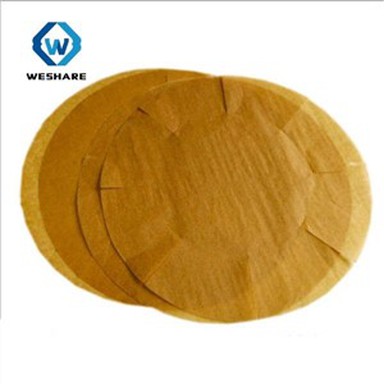
Steamer Baking Paper Sheet
Steaming is not baking. Inside a bamboo or stainless steamer the liner works at around 100 °C in condensing, humid steam — not in dry oven air. A sheet that shrugs off 230 °C of dry heat can still soften, split, or fuse itself to a dumpling once it is hot and wet. So a steamer liner has to be specified on wet strength, coated-side orientation and steam circulation, not on temperature alone. WeShare supplies steamer baking paper sheets as pre-cut round liners for bamboo baskets, flat sheets and rolls for metal trays and combi steamers, and perforated versions for high-moisture products. Grammages run 30–60 gsm, diameters from 75 mm to 229 mm and custom, and the paper is food-grade and silicone-coated on one or both sides.
- Fast Delievery
- Quality Assurance
- 24/7 Customer Service
Product Introduction
Products Description

Steaming is not baking - why the specification changes
| Baking (oven) | Steaming (basket) | |
|---|---|---|
| Medium | Dry hot air | Condensing, saturated steam |
| Temperature | 180–230 °C | ~100 °C at standard atmospheric pressure (higher only in a pressurised commercial steamer) |
| Main threat to the paper | Heat and browning | Water and condensate |
| Governing spec | Heat resistance | Wet strength, release, and steam circulation |
The two jobs are the same - stop the food sticking, keep it off the rack - but the failure modes are not. This is the most common and most expensive sourcing mistake in the category: buying an oven paper for the baskets and discovering in service that it collapses when wet.
Wet strength:
Steam condenses on the sheet and drips back onto it. A liner that is not wet-strong softens, splits, or comes apart mid-batch - and you find out when a hot dumpling tears through it.
Oven papers are not automatically wet-strong. Wet strength is a separate property from dry tensile strength, and it has to be specified as such: wet tensile strength (N/25 mm), or a wet-strength retention figure.
| Situation | Why wet strength matters most |
|---|---|
| Frozen dim sum steamed straight from the freezer | Ice melt plus steam is the harshest condensation case in the kitchen |
| Holding / display over steam (bao warmers) | The sheet must not delaminate after an hour over the steam well |
| Stacked loads in a combi steamer | The lower sheets carry the weight of everything above them, wet |
| Long, high-moisture cycles (rice cakes, sticky rice) | Prolonged saturation |
Coated side up - and one-side vs two-side coating
On a single-side-coated sheet, the coated side is the food side. Most brands mark it; if yours does not, you will get inconsistent release and the complaint that "some sheets stick".
Two-side coated removes the orientation question entirely, at a higher cost. It is the safer choice for high-volume kitchens and for staff who will not check.
Uncoated does not mean non-stick. If the sheet carries no silicone, it cannot be sold as a non-stick liner - the food will bond to wet starch.

Perforated or plain - and why an oversized sheet blocks the steam
Perforation.
Perforated sheets have small holes that let steam rise through the liner instead of being trapped under it. Use them where the product is high in moisture and you want even cooking; plain sheets are fine for most dim sum.
Sheet size
A sheet that completely seals the basket base slows the steam. Standard practice is to keep the liner slightly smaller than the rim so steam can rise around the edge - or to size it to the flat inner base rather than cupping the wall.

Sizing to your steamer basket
Order to the inner diameter of your basket, and tell us which part the circle must fit.

| Basket nominal size | Typical inner diameter | Notes |
|---|---|---|
| 6 in | ≈ 150 mm | Small / dumpling baskets |
| 7 in | ≈ 175 mm | Retail / household |
| 8 in | ≈ 200 mm | Most common restaurant size |
| 9 in | ≈ 229 mm | Restaurant |
| 10 in | ≈ 254 mm | Large batches |
| 12 in | ≈ 305 mm | Catering |
Which liner for which steaming job
| Steaming job | Recommended liner | Why |
|---|---|---|
| Bamboo steamer, dine-in dim sum | Pre-cut round, silicone-coated, plain | Sized to the basket; coated side up; simple and fast |
| Dine-in / high-moisture products | Pre-cut round, perforated, coated | More steam pass-through; less condensation pooling |
| Stainless perforated trays / hotel pans / combi steamer | Flat sheet or roll, cut to tray; wet-strong coated or parchmentized | Tear resistance matters more than circle shape at this footprint |
| Frozen dim sum steamed from freezer | Coated round liners with higher wet strength | Ice melt + steam is the harshest case |
| Holding / display over steam | Coated paper sized to the well | Must not delaminate over long humid exposure |
| Interleaving frozen product in boxes | Coated or greaseproof interleaving sheets | This is a freezer/transport job, not a steam job |
| Retail / household | Pre-cut round in a printed colour box | Consumer pack, sized to household 7–8 in baskets |

Failure modes: what goes wrong in the basket, and why
| What the kitchen sees | Real cause | Fix |
|---|---|---|
| Dumplings stick and tear | Coated side down; or uncoated sheet; or release value too high | Confirm coated side up; specify a lower-release coating |
| Soggy bun bottoms | Condensation trapped under a sealed liner | Perforated sheet; or size the liner slightly smaller than the rim |
| Sheet splits or disintegrates mid-batch | Insufficient wet strength | Specify wet tensile strength, not just GSM |
| Sheet fuses to the food | Condensation + low release + long cycle | Higher-release coating; shorter cycle; perforation |
| Liner smells or discolours in the basket | Paper not intended for hot humid food contact | Specify food-contact scope for hot/aqueous conditions |
| Inconsistent release across a pack | One-side-coated sheet with no orientation mark | Switch to marked single-side or two-side coated |
| Food slides off onto the bamboo | Circle smaller than the basket base | Re-size to the basket's inner diameter |
FAQ
Q1. Is steamer paper the same as baking paper?
They come from the same paper families, but the jobs differ. Steaming is wet and around 100 °C; baking is dry and 180–230 °C. The governing specification for a steamer liner is wet strength, not dry-heat tolerance. Baking paper is not automatically the right sheet for a steam basket.
Q2. Why is 220 °C not the headline specification for a steamer liner?
Because the steamer never reaches 220 °C. Quoting an oven temperature tells a professional buyer nothing about how the sheet behaves in condensing steam. We quote wet strength, coating side and steam circulation instead - and we do state the dry-heat limit for customers who also use the sheet in an oven or air fryer.
Q3. Which side of the liner faces up?
On a single-side-coated sheet, the coated side is the food side. Ask for marked sheets, or specify two-side coating to remove the question.
Q4. Should I choose perforated or plain?
Perforated sheets let steam through the liner and reduce condensation pooling - useful for high-moisture products and for frozen dim sum steamed straight from the freezer. Plain sheets are fine for most standard dim sum.
Q5. What size liner fits my steamer?
Measure the basket's inner diameter. Common bamboo steamers run 6–12 in (≈150–305 mm). Tell us whether the circle must fit the flat inner base or cup against the wall, and we will match the die-cut.
Q6. Why do my dumplings stick or go soggy?
Usually trapped condensation or the wrong release side, not "the wrong paper". Check that the coated side is up and that the sheet is not sealing the basket base. If it persists, move to a perforated or higher-release sheet.
Q7. What grammage should a steamer liner be?
Most food liner papers run roughly 30–60 gsm. Single-use round sheets are usually at the lighter end; large tray and combi formats are heavier for tear resistance.
Q8. Do you supply liner paper for frozen dim sum production lines?
Yes. Lines running frozen product straight into steam need the highest wet strength because ice melt and steam combine. Tell us your cycle time and product, and we will match the grade.
Q9. Can the liner be printed or branded?
Yes - up to two colours, including logo and brand designs, on flat sheets and on retail colour-box packs.
Q10. What is the MOQ and lead time?
MOQ is confirmed per size and format; lead time is typically 7–15 days for small quantities and around 30 days for large orders.
Hot Tags: steamer baking paper sheet, China, suppliers, wholesale, buy, price, Baking Paper, Silicone Baking Paper Sheet