


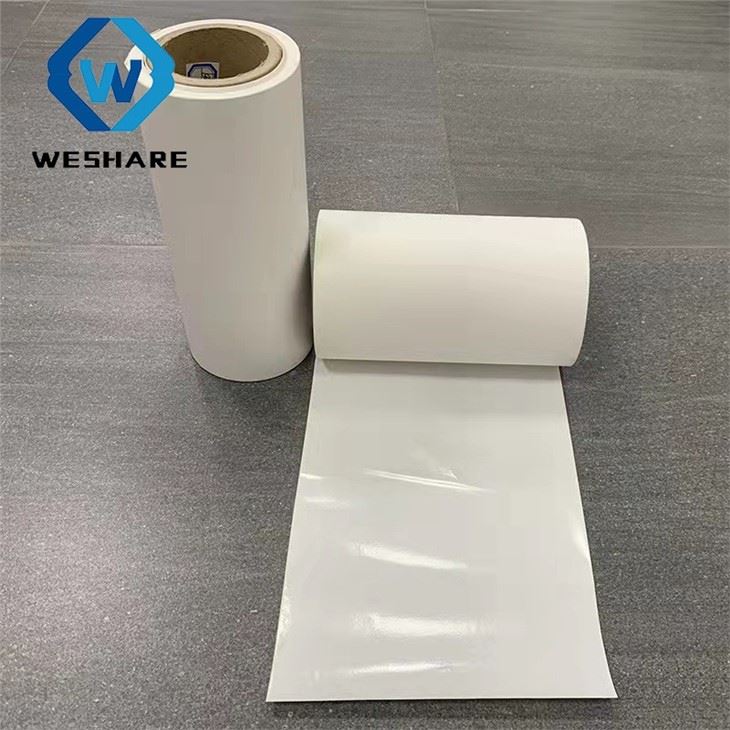


Brown Kraft Release Paper Single Sided
Brown kraft release paper is a single-sided release liner built on unbleached kraft base paper. One face carries the silicone release coating; the other stays bare, and can be printed, coated or left as the natural brown surface. Kraft behaves differently from glassine, and it is worth knowing why before you choose. Glassine is supercalendered and dense — it holds silicone well and needs little of it. Kraft is stronger and cheaper, but its fibre structure is more open, so silicone (and later, your adhesive) can migrate into the paper. That is why a kraft liner of this type normally carries a PE layer of 11–15 g between the paper and the silicone.
- Fast Delievery
- Quality Assurance
- 24/7 Customer Service
Product Introduction
Products Description

What Is Brown Kraft Release Paper?
A brown kraft release paper is a release liner whose base paper is unbleached kraft. It is coated with silicone on one face. The other face is left uncoated.
Three things define it:
| Element | What it is | Why it matters |
|---|---|---|
| Unbleached kraft base | Natural brown kraft paper, no bleaching stage | Colour, cost, and higher strength than a highly refined paper |
| PE barrier 11–15 g | A polyethylene layer between paper and coating | Prevents silicone and adhesive soaking into the open kraft fibre |
| Single-sided silicone | Solvent or solvent-free release coating on one face | Releases the adhesive; leaves the reverse side free for printing |
Why Choose Unbleached Kraft? Strength, Cost and Appearance
| Advantage | Explanation |
|---|---|
| Higher strength | Kraft fibres are less refined than glassine fibres, giving higher tensile and tear strength - an advantage on wide, heavy or high-tension rolls |
| Lower cost | No bleaching stage, and a less refined furnish. The savings show up in price per m² |
| Natural brown appearance | Where the liner will be visible, brown reads as industrial and sustainable rather than as a defect |
Single Sided: What You Can Do With the Uncoated Back
This is the practical reason most customers choose a single-sided liner over a double-sided one - the second face is available.
| Use of the reverse face | Why it helps |
|---|---|
| Print your brand or logo | Branding or product identification directly on the liner |
| Print variable data | Batch codes, dates, instructions |
| Print instructions or handling notes | Common on envelope strips and consumer-facing applications |
| Leave bare (natural brown) | For industrial uses where the liner is visible |

Why a Kraft Liner Usually Needs a PE Barrier
Kraft paper is an open, porous structure. Without a barrier:
Silicone soaks in. The coating partly disappears into the paper instead of sitting on the surface, so release becomes weaker and less consistent - and you end up paying for more silicone than you need.
Adhesive strikes through. Later, when the liner is laminated to your adhesive, plasticiser or low-viscosity adhesive can migrate through the paper. The symptom is a liner that works on one face and grabs on the other, or worse, contaminates the reverse face.
A PE layer of 11–15 g closes the surface before coating. This is standard practice for kraft-based liners - the liner family is often referred to as PEK (PE-coated kraft) for exactly this reason.
When you might not need it: for very light, dry adhesive systems, at high grammages, or where the liner is not stored long. Ask us - an unnecessary PE layer is a real cost per m².

Silicone Coating and Release Force
System. Both solvent-based and solvent-free silicone are available. Solvent-free is the more common choice today for cost and environmental reasons; solvent-based still has a place in some release profiles .
Release force is measured by peeling a standard test tape off the liner at 180° and 300 mm/min . Always ask which test tape was used - a release figure without that is not comparable between suppliers.
Cure and anchorage. Poorly cured silicone transfers onto the adhesive. Ask for a rub-off result, not only a release force number.
Uniformity across the web. If the release differs from the centre to the edges, the liner cannot be used for demanding die-cutting. Coat weight is checked by measurement across the web.
Application Guide
| Application | Why brown kraft single sided fits | Notes |
|---|---|---|
| Self-adhesive label backing | Kraft backing paper for labels where glassine is not required | check release force for your adhesive |
| Envelope self-adhesive strips | Liner protects the gum strip and releases on opening | low grammage possible |
| Adhesive paper & adhesive fabric | General backing for adhesive-coated webs | |
| Artificial / synthetic leather | Release and embossing support | confirm surface requirements |
| Packaging & protective interleaving | Strength and cost matter more than surface smoothness | |
| Branded liner (printed reverse) | Reverse face printed with brand or instructions |
How to Specify and Test Before You Order
Five checks to run on a sample with your own adhesive:
| # | Check | What to look for |
|---|---|---|
| 1 | Release force on your adhesive | measured at your line speed, not only on a standard test tape |
| 2 | Silicone rub-off | rub the coated face - no smear, no dull patch |
| 3 | Adhesive strike-through | laminate, age warm, then re-check the reverse face |
| 4 | Curl and stiffness | kraft is stiffer than glassine; confirm it tracks on your machine |
| 5 | Reverse-face printability |
if you plan to print, test your ink or the printer's ink on the bare face
|

Hot Tags: brown kraft release paper single sided, China, suppliers, wholesale, buy, price, Silicone Release Paper For Foam


