

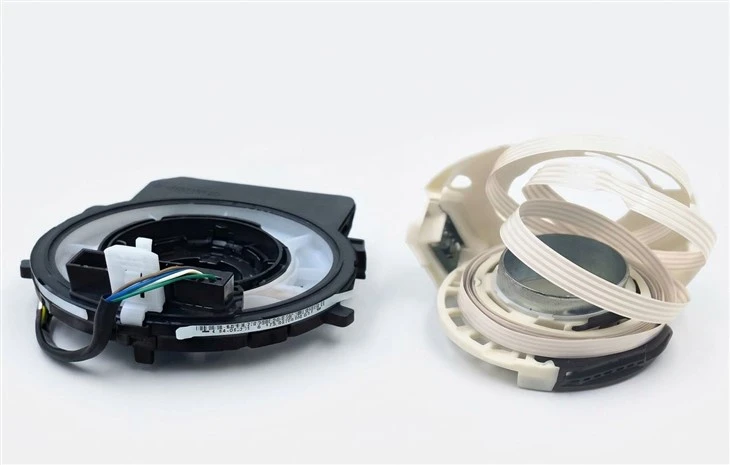
Clock Spring FFC Adhesive Film
Thermosetting FFC adhesive film for clock springs: 5.5 million flex cycles at 7 mm radius, -40 to 125 °C, conductor-edge encapsulation, 3-inch rolls.
- Fast Delievery
- Quality Assurance
- 24/7 Customer Service
Product Introduction
Products Description
FFC Hot Melt Adhesive Film for Clock Spring Harnesses (105 / 125 °C)
A clock spring bond line rarely fails because the cabin gets hot. It fails because the same few millimetres of cable are bent, straightened and bent again for the life of the vehicle, at a radius small enough to concentrate every bit of strain in the adhesive layer. Temperature only decides how fast that happens.
This is the series built for that duty cycle: a thermosetting hot melt adhesive film qualified on flex endurance first and thermal margin second, in grades PB2101, PB2105, PB2106 and PB3129.
Why dynamic FFC bonds delaminate
Three mechanisms dominate in steering-wheel and seat harnesses:
Adhesive creep under sustained load. At 85–105 °C a thermoplastic bond line slowly flows. Once it thins at the bend, the copper begins to separate from the base film.
Copper fatigue before adhesive failure. If the adhesive is stiff enough to hold, the strain transfers into the conductor instead and the copper work-hardens at the bend.
Heat-aging embrittlement. A film that survives 136 °C for a week may still crack when bent afterwards. Delamination after soak-and-bend is the failure mode that most often slips through incoming inspection.
A thermosetting adhesive answers the first and third mechanism: it crosslinks during lamination, so the bond line cannot re-flow in service and does not embrittle on the same curve as a thermoplastic.
Products Structure
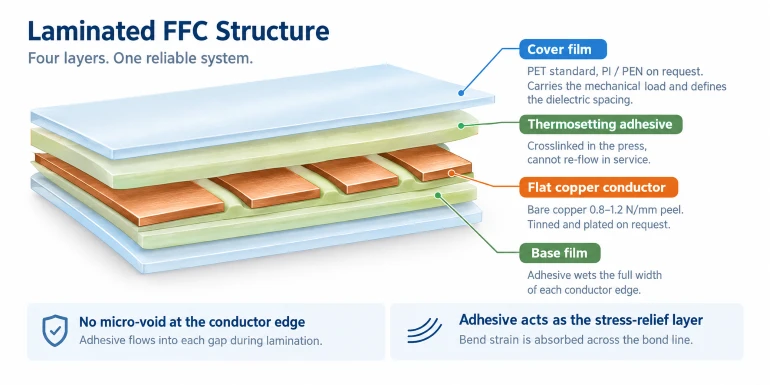
The laminate is a four-part system, and each part has one job:
Cover film and base film carry the mechanical load and define the dielectric spacing. They must not move relative to the conductors during cure.
Adhesive does two things at once: it wets the conductor edge so there is no void for moisture to enter, and it forms the compliant layer that absorbs bend strain instead of passing it into the copper.
Copper conductor is the only layer with a finite fatigue life. Every design decision on this page is made to move strain away from it.
Substrate compatibility
| Substrate | Status on this platform |
|---|---|
| PET (polyester) base and cover film | Standard. The primary FFC construction and the default for clock spring laminations. |
| PI (polyimide) | Available on request. Specify where the finished part also passes a solder or reflow step - the PI carrier construction is the right answer there. |
| PEN (polyethylene naphthalate) | Available on request, subject to a lamination trial on your press. |
Conductor compatibility
| Conductor | Status |
|---|---|
| Flat bare copper | Fully qualified. Peel 0.8–1.2 N/mm, tested on the constructions in the table below. |
| Flat tinned copper | Available. Recommend re-validating peel - tin reflow at lamination temperature changes the interface. |
| Nickel or silver plated copper | Quoted per application after a bond trial. |
Fluid and environmental exposure
Automotive harnesses in a door or column see grease from the mechanism, interior cleaners, hand contact and, on exposed routings, salt spray. We do not publish blanket "resistant to automotive fluids" claims, because the answer depends entirely on the fluid list and the exposure duration your specification uses.
Send the fluid list from your validation plan and we will run the corresponding immersion or spray test and report actual peel retention, rather than a pass/fail badge.
Verified performance
All figures below are in-house test data on the PB2101 and PB3129 constructions, benchmarked against imported films from US and Japanese suppliers.
| Test | Condition | PB2101 | PB3129 | Imported benchmark |
|---|---|---|---|---|
| Film-to-film peel | - | substrate failure | substrate failure | substrate failure |
| Film-to-bare-copper peel | - | 0.8–1.2 N/mm | 0.8–1.2 N/mm | 0.53–1.0 / 0.8–1.0 N/mm |
| Flex life at 105 °C | 7 mm bend radius | 1.7–2.0 million cycles | 2.0–3.0 million cycles | 1.2–2.0 million cycles |
| Heat aging | 136 °C × 7 d, then bend | no delamination | no delamination | one benchmark delaminates |
| Heat aging | 158 °C × 7 d, then bend | delamination | no delamination | both delaminate |
| Damp heat | 85 °C / 85 % RH | 100 h | 2000 h | 100 h |
| Cold bend | -40 °C × 96 h, then bend | no delamination | no delamination | no delamina |
Choosing between the grades
| Grade | Position |
|---|---|
| PB2101 | Baseline flex grade. Correct choice for power window, power seat and general moving harnesses where 136 °C aging and 105 °C continuous are the ceiling. |
| PB2105 / PB2106 | Intermediate variants of the same platform, specified where the lamination process or base film dictates a different flow window. |
| PB3129 | The margin grade. Survives 158 °C × 7 d without delamination and holds 2000 h of damp heat, for clock springs packaged next to a heated column or for platforms that run the same part through a harsher validation cycle. |
Standards and compliance
| Requirement | Status |
|---|---|
| UL flame retardant certification | The construction is capable of passing UL certification. Grade and wall thickness must be confirmed for the specific file. |
| ISO 6722 / LV 214 / USCAR-2 | Referenced as test methods, not as certifications. State clearly which clauses were run if you cite them. |
Applications
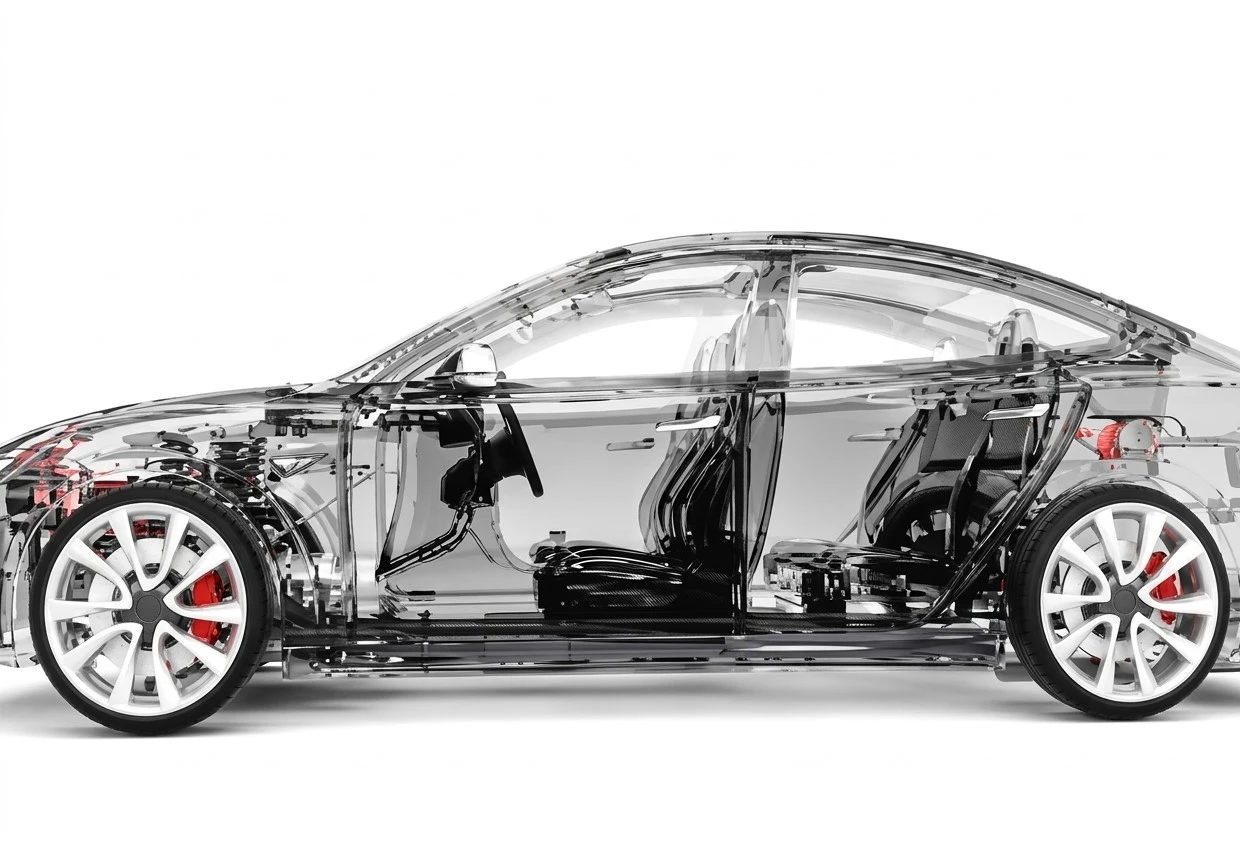
Airbag clock spring FFC
Power window and sunroof actuator harnesses
Power seat track harnesses
Any FFC that sees repeated rolling or sliding bend in service
certificate

FAQ
Does the film pass UL flame retardant testing?
The construction is capable of passing UL flame retardant certification. Confirm the specific grade and wall thickness with us before finalising the drawing.
What bend radius is the flex data based on?
7 mm. If your routing is tighter than that, send us the geometry - bend radius is the single variable that moves flex life most, and it is worth re-testing rather than extrapolating.
Can it be supplied narrow enough for a small clock spring?
Yes - the film is supplied slit to width. Send the finished FFC width and your die layout, and confirm the minimum land beside the outermost conductor so the edge encapsulation requirement is still met.
Can it drop into an existing imported-film process?
The film is designed as a drop-in for the US and Japanese films used in clock spring lamination today, with a higher copper peel ceiling. Lamination window and cure schedule should be re-validated on your line.
Hot Tags: clock spring ffc adhesive film, China, suppliers, wholesale, buy, price
No Information
No Information


