

How to choose the right mica grade for insulation?
Apr 14, 2026
Mica Insulation Material Selection Guide
For Industrial & Electrical Applications | Hangzhou Weshare Imp. & Exp. Co.,Ltd.
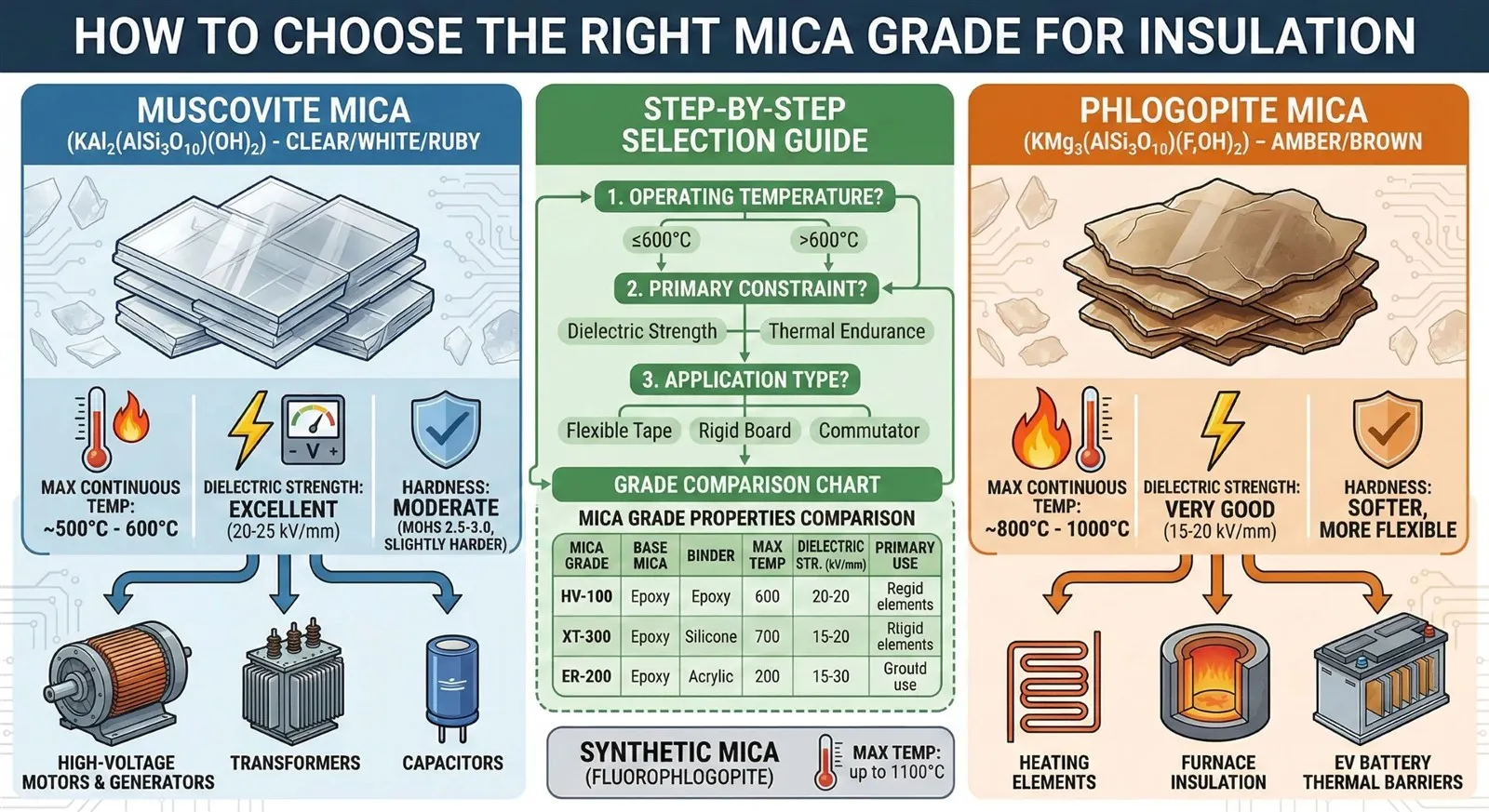
You can select the appropriate mica grade based on your project's specific performance requirements to achieve ideal insulation results. Mica stands out for its exceptional properties: excellent electrical insulation, high thermal resistance, and outstanding mechanical stability. These characteristics make it the material of choice for industries including aerospace, electric vehicles, iron and steel foundry, consumer appliances, and the electrical sector. Matching mica's advantages to your insulation needs will simplify your selection process, and this guide will help you make decisions with confidence.
Key Properties of Mica for Insulation
Excellent thermal insulation performance
High dielectric strength
Enhanced mechanical reliability
Summary
Define your insulation requirements by considering operating temperature, electrical demands, and environmental conditions.
Choose muscovite or phlogopite according to their unique properties:Muscovite is ideal for applications requiring high electrical strength, while phlogopite performs better in high-temperature environments.
Use a checklist to evaluate mica grades, focusing on certifications, compliance, and mechanical strength to ensure safety and reliability.
Select the proper mica sheet thickness for your application: thicker sheets provide superior protection in high-temperature environments.
Consult expert resources and technical data sheets to make informed decisions and avoid common pitfalls in mica selection.
Mica Grades for Insulation
Muscovite vs. Phlogopite
Muscovite and phlogopite are the two primary types of mica used as insulation materials, each offering distinct advantages for targeted applications.
Muscovite provides excellent electrical insulation and good mechanical strength.
Phlogopite delivers superior performance in high-temperature applications and remains thermally stable under heat stress.
Tip: Use the table below to compare key properties of muscovite and phlogopite, helping you choose the right mica tape for insulation engineering.
表格
| Property | Muscovite | Phlogopite |
|---|---|---|
| Continuous Heat Resistance | 500°C | 700°C |
| Tensile Strength | 150 N/mm² | 110 N/mm² |
| Flexural Strength | 230 N/mm² | 170 N/mm² |
Phlogopite withstands higher temperatures, making it preferred for high-temperature applications. Muscovite offers superior mechanical strength, critical for electrical insulation in durable equipment.
Common Applications
Muscovite Mica
Widely used for its outstanding electrical insulation properties:
Capacitors, electrical insulators, and transmission cables
Substrates for semiconductor devices and microwave circuits
Drilling mud improvement and filtration in oil & gas exploration
Automotive coatings to enhance durability and appearance
Phlogopite Mica
High-performance insulation for demanding environments:
Furnace linings, heat shields, and welding equipment
Automotive brake pads and gaskets
Filler in plastics and rubber compounds
Building materials such as cement and fire-resistant boards for improved safety
Rocket nozzles and heat shields in aerospace
Insulation in solar panels and wind turbine blades for renewable energy systems
Note: Mica tape made from muscovite or phlogopite provides reliable electrical insulation and thermal protection. Always select the appropriate mica grade based on your specific insulation requirements.
Critical Properties to Compare
Temperature Resistance
Temperature resistance is one of the most important factors when choosing mica for insulation. Mica excels in extreme high-temperature environments.
| Mica Type | Temperature Range (°C) |
|---|---|
| Muscovite | 500 – 700°C |
| Phlogopite | 800 – 1000°C |
Phlogopite is the preferred choice for high-temperature insulation. Muscovite offers reliable performance and strong mechanical strength for most general electrical equipment.
Dielectric Strength
Dielectric strength measures mica's ability to resist electric current. Mica significantly outperforms many other insulation materials:
Mica: 50 – 150 kV/mm
Fiberglass: 19 – 24 kV/mm
Mica provides exceptional resistance to electrical breakdown, preventing arcing and short circuits to ensure equipment safety. It maintains stable dielectric strength even at high temperatures, making it ideal for furnaces, power plants, and aerospace systems.
Mechanical Strength & Flexibility
Consider mechanical strength and flexibility when selecting mica:
Mica sheets are lightweight and easy to handle.
They can be bent without breaking, suitable for flexible insulation applications.
Excellent heat resistance and chemical corrosion resistance ensure long service life.
Muscovite is recommended for projects requiring high mechanical strength, while phlogopite is better for applications prioritizing flexibility and high-temperature resistance.
| Property | Description |
|---|---|
| Flexibility | Can be split into thin, flexible layers for versatile fitting |
| Lightweight | Low density for easy transportation and installation |
| Thermal Resistance | Withstands high temperatures for extreme operating conditions |
| Compressive Strength | Resists thermal stress and chemical exposure for enhanced durability |
| Dielectric Strength | Excellent electrical insulation performance |
Sheet Thickness & Shape
Mica sheet thickness directly impacts insulation and protective performance:
Thick sheets (1 mm+): Best for extreme heat environments above 800°C, offering excellent thermal resistance and mechanical protection.
Motors & Generators: Recommended thickness 0.2 mm – 0.5 mm.
Industrial Furnaces: Recommended thickness 1.0 mm – 1.5 mm.
Thicker mica sheets also improve dielectric strength, enhancing safety in high-voltage applications. Always match mica thickness to your specific application for optimal performance.
How to Choose the Right Mica Grade
Step 1: Define Your Insulation Requirements
First, clarify the specific demands of your insulation project:
Identify the operating environment (indoor / outdoor, exposure to physical damage).
Determine which components of equipment or pipelines require insulation.
Calculate optimal insulation thickness using tools such as 3E Plus® software to improve efficiency and insulation performance.
Document all specifications in a technical data sheet for consistent team reference.
Clear documentation helps avoid errors and ensures proper mica grade selection.
Step 2: Match Requirements to Mica Properties
Align your insulation needs with mica performance characteristics:
High-temperature applications: Choose phlogopite.
High electrical insulation + mechanical strength: Choose muscovite.
Select sheet thickness and shape based on installation needs: thicker sheets for high temperatures, flexible sheets for curved surfaces.
Verify compliance with industry safety standards and voltage requirements.
Matching mica properties to application conditions ensures long-lasting, reliable insulation for motors, generators, and other electrical equipment.
Step 3: Use the Selection Checklist
Use this checklist to evaluate mica grades and avoid oversights:
| Factor | What to Check |
|---|---|
| Certifications | ISO 9001:2015, UL Certification, RoHS Compliance |
| Compliance | Meets industry and safety standards |
| Warranty | Manufacturer warranty covering material defects |
| Cost & Quality | Competitive pricing with reliable quality and support |
| Temperature Resistance | Meets operating temperature requirements |
| Dielectric Strength | Delivers required electrical insulation |
| Mechanical Strength | Suitable for durability or flexibility needs |
| Thickness & Shape | Compatible with equipment and installation |
| Environmental Adaptability | Performs reliably in service environment |
This step-by-step approach ensures optimal performance and durable protection for electrical and heater insulation applications.
Additional Decision Factors
Cost & Availability
Mica pricing depends on raw material quality, processing techniques, and market demand. Supply can be affected by mining conditions, regional policies, and geopolitical factors. Tariffs and trade regulations may also influence procurement costs.
High demand for specialty mica grades in electric vehicles and energy storage can further affect availability. Many businesses prioritize local suppliers or multi-source strategies to reduce lead times and supply risks.
Compliance & Safety
Ensure mica insulation materials meet critical safety standards that protect personnel and equipment in electrical applications:
| Standard | Description |
|---|---|
| ISO 20457 | Specifies mica-based electrical insulation materials |
| IEC 60371 | Covers thermal, electrical, and mechanical durability |
| IEC 60664 | Defines insulation coordination in electrical systems |
| IEC 60243 | Tests dielectric strength of mica sheets |
| UL 94 | Evaluates flammability of mica insulation |
| UL 746 | Assesses safety of polymeric materials in electrical devices |
| UL 1446 | Tests long-term performance of insulation systems |
Also verify ISO 9001, UL safety, RoHS, and REACH certifications for quality, safety, and environmental compliance.
Environmental Conditions
Mica performs reliably in harsh environments:
Thermal Resistance: Stable at temperatures above 1000°C without decomposition.
Hygroscopicity: Low water absorption, stable in high humidity.
Corrosion Resistance: Resists chemicals and moisture while retaining insulation properties.
Properly installed mica insulation can last more than 50 years, reducing maintenance costs and extending service life even under severe conditions.
Mica Selection Process
Define application requirements (thermal, electrical, mechanical).
Select mica type based on operating temperature and project needs.
Verify supplier technical data sheets.
Check dimensional accuracy for tight-fitting components.
Evaluate supplier reliability and service capabilities.
Avoid unclear claims or missing return policies.
Mica delivers high dielectric strength, excellent heat resistance, and reliable mechanical durability, making it the ideal solution for safe, long-lasting industrial insulation systems.


