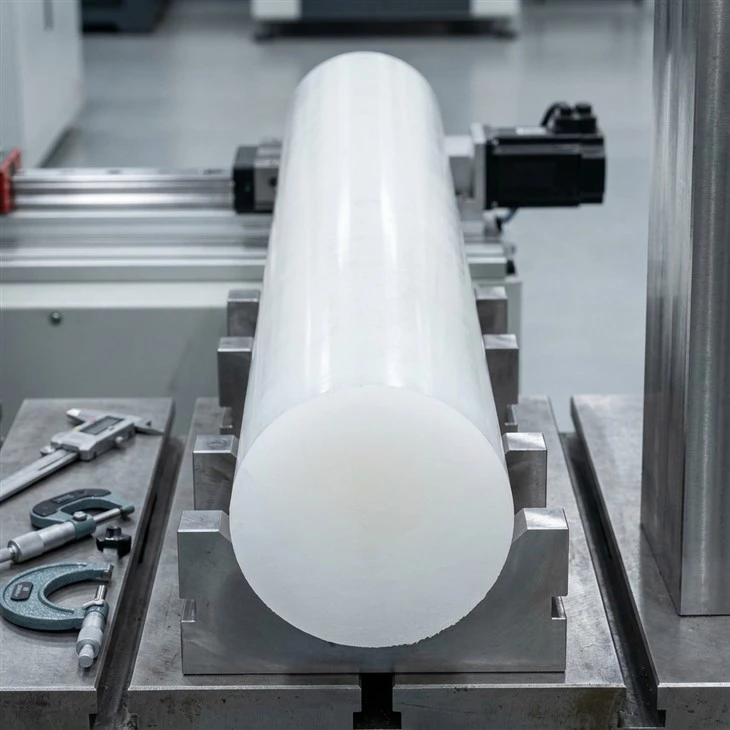
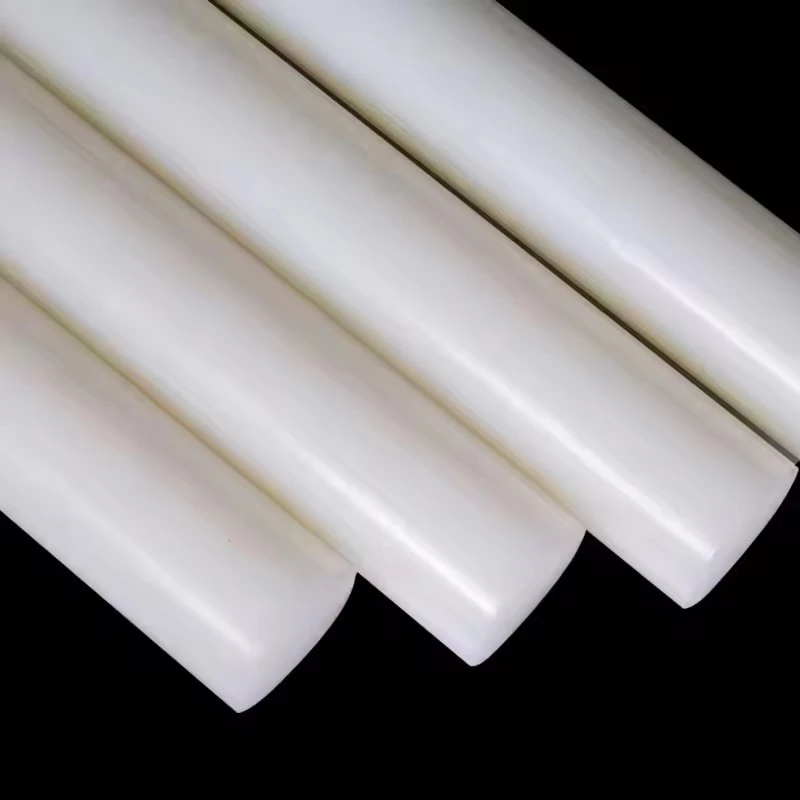
Natural white PVDF rod supplied in multiple diameters for CNC machining
PVDF Rod — Extruded and Compression Moulded Stock for CNC Machining PVDF rod is polyvinylidene fluoride supplied as solid round bar, for turning, milling and drilling into finished parts — bushings, wear rings, sleeves, valve and pump components, insulators and laboratory fixtures. It is bought by machine shops and OEMs, so it is specified like a machining stock, not like a plastic: by the way it was made, by its diameter tolerance, and by how straight and round it arrives. Those three things decide whether your part comes off the machine concentric and on size — and they are the three things most PVDF rod pages leave out. Material: 100% virgin PVDF (polyvinylidene fluoride) — homopolymer grades Forms: extruded rod · compression moulded rod Diameter: 3 – 200 mm (confirm your actual split by form — see Part D) Colour: natural / semi-translucent white Forms of supply: cut lengths to order · stress-relieved rod on request Related: for large flat sections use PVDF board; for welding PVDF fabricated assemblies use PVDF welding rod.
- Fast Delievery
- Quality Assurance
- 24/7 Customer Service
Product Introduction
Product Description:
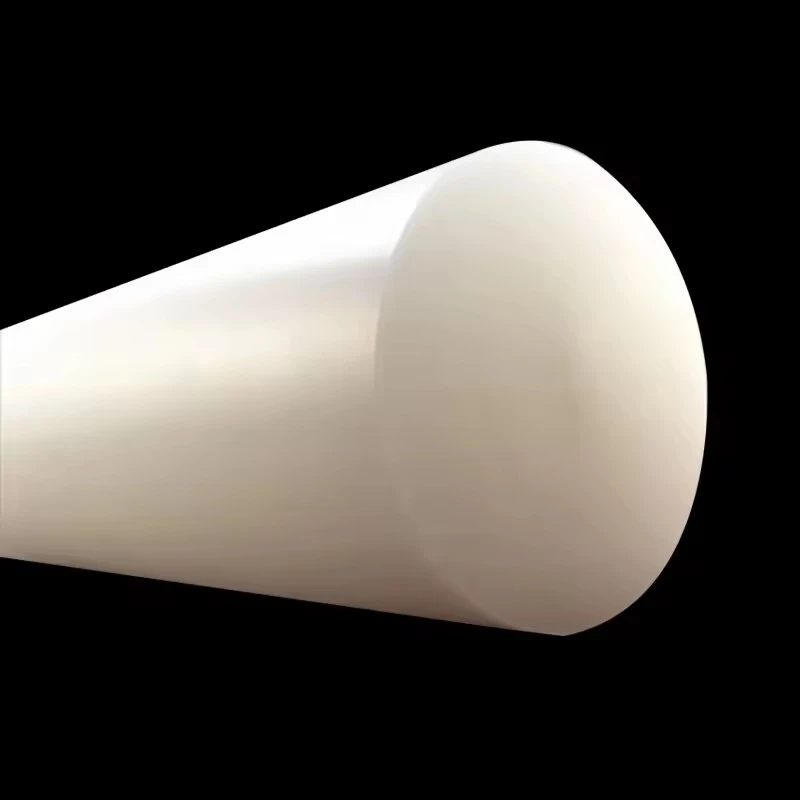
What PVDF Rod Is Made From
PVDF is polyvinylidene fluoride - a fluoropolymer with a fluorinated backbone, supplied as melt-processable rod stock. Note the name precisely: it is vinylidene fluoride, which is a different polymer from vinyl fluoride (PVF).
What that chemistry buys you in a machined part:
| Property | Why it matters for a turned part |
|---|---|
| Chemical resistance | Holds up in acid and oxidiser service where metals corrode |
| Stiffness and tensile strength (~50 MPa) | The part can carry load without the creep you get with PTFE |
| Creep resistance | A machined bush or wear ring keeps its fit under sustained load |
| Low friction, self-lubricating | Runs against a shaft without external lubrication |
| UV and weather resistance | Survives outdoor and splash-zone service |
| Continuous service to 150 °C | Wider than PVC or PP |
| Weldable | Rod can be welded to sheet, board and pipe with PVDF welding rod |
Extruded or Compression Moulded?
PVDF rod is produced two ways, and the difference is not cosmetic. It determines the maximum diameter you can buy, the density and porosity of the bar, the residual stress inside it, and the price.
| Extruded rod | Compression moulded rod | |
|---|---|---|
| How it is made | Melt pushed continuously through a die | Resin consolidated under heat and pressure in a tool |
| Typical diameter | Small to medium | Medium to large |
| Surface as supplied | Smooth, as-extruded | Machined / planed |
| Density and porosity | Slightly higher porosity | Denser, lower permeability |
| Residual stress | Higher - extrusion orients the polymer | Lower, but the distribution differs through the section |
| Cost at small diameter | Lower | Higher |
| Cost at large diameter | Limited and increasingly costly | Standard route |
| Best for | High-volume small turned parts, spacers, insulators | Large diameters, thick sections, sealing, vacuum and chemical duty |
Why porosity matters: in independent permeability testing on fluoropolymer rod, extruded bar has been reported at roughly 15 % higher air permeability than moulded bar of the same thickness (ASTM D737). For a sealing or vacuum-facing part, that difference is the reason to choose moulded. For a spacer or an insulator, it is irrelevant, and extruded is the cheaper answer.
Our recommendation: tell us the part and the service, and we will tell you which form to buy. Buying moulded rod for a spacer, or extruded rod for a vacuum seal, are both common and both more expensive than they need to be.
Diameter, Tolerance, Roundness and Straightness
This is where a rod specification is actually written - and where most suppliers give you nothing.
Diameter - typical range by form
| Form | Diameter range | Standard length |
|---|---|---|
| Extruded rod | 3 – 100 mm | 1,000 / 2,000 mm |
| Compression moulded rod | 20 – 200 mm | 100 – 1,000 mm |
Diameter tolerance - typical
| Nominal diameter | Tolerance |
|---|---|
| Up to 25 mm | ± 0.20 mm |
| 25 – 50 mm | ± 0.30 mm |
| 50 – 100 mm | ± 0.50 mm |
| Over 100 mm | ± 0.80 mm |
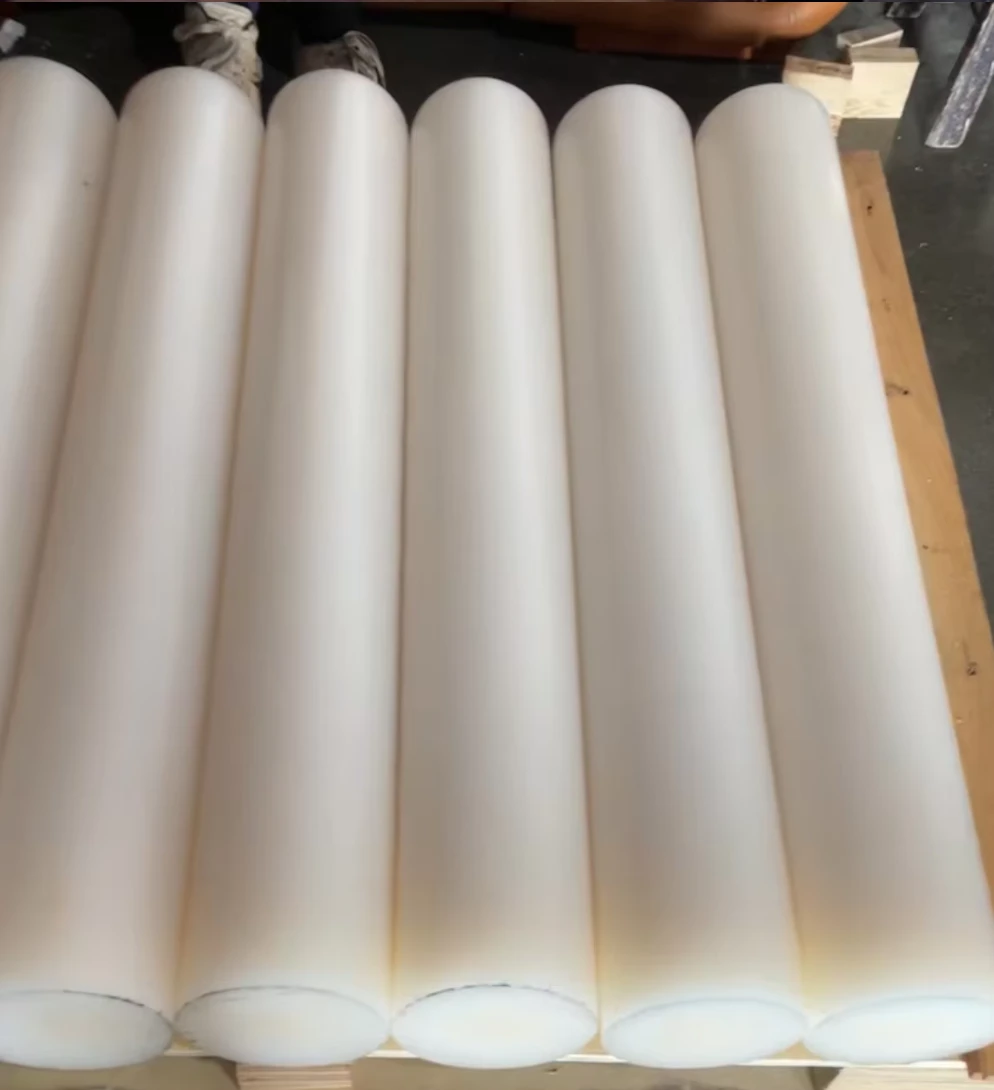
Roundness (ovality). A rod that is not round forces you to take a deeper first cut to clean up the whole circumference - which costs material, time and concentricity. Specify roundness within the diameter tolerance, or tighter where the part is thin-walled.
Straightness (bow). Bow matters most on long or slender parts: a bowed bar cannot be turned concentric between centres without first roughing it true. Specify straightness as a deviation over a stated length - for example, ≤ 1 mm per 1,000 mm (confirm the figure you can actually hold).
Why this is the section that wins the order: a machine shop can tolerate a modest diameter tolerance if it is consistent. What stops a lathe is a bar that is oval, bowed, or that varies from bar to bar.
Stock Lengths and Surface Condition
| Parameter | Options |
|---|---|
| Length | Cut to your finished part length plus allowance; standard 1,000 / 2,000 mm for extruded |
| Cut tolerance | [state your cutting tolerance] |
| Surface | As-extruded · machined / planed · centreless ground (on request) |
| Colour | Natural / semi-translucent white |
| Ends | Square cut · chamfered · deburred |
| Stress relief | Annealed on request - recommended for close-tolerance machining |
| Packaging | Bundled, protected against bowing and surface damage in transit |
Machining PVDF Rod: Turning, Drilling and Stress Relief
Written for the machinist. Following these keeps a PVDF part on size; ignoring them is how parts crack after machining.
Stress relief first. Rod carries internal stress from the way it was formed, and machining releases it. For any close-tolerance part, anneal the rod before the finishing cuts - the same principle applies after machining, where a post-machining anneal is standard practice to reduce stress in PVDF. Rough machine, anneal, then finish.
Holding the work.
Do not over-tighten chucks or collets. PVDF creeps under sustained compressive load, so an over-tightened collet distorts the bar and releases only after the cut.
Drilling and threading.
Drill oversize and allow clearance for thermal expansion - PVDF expands roughly 1.2 – 1.4 mm per metre for every 100 °C rise (coefficient of linear thermal expansion ≈ 12 – 14 × 10⁻⁵ K⁻¹).
Use sharp drills with good clearance and withdraw frequently to clear chips.
Cut threads with generous clearance; avoid tight-fitting metal fasteners that will stress the plastic.
Joining. PVDF rod can be welded to PVDF sheet, board and pipe using PVDF welding rod, so a fabricated assembly can mix machined rod components with welded sheet construction. See PVDF welding rod for consumable selection.

Rod or Sheet? Why Turned Parts Start From Rod
| Rod | Sheet / board | |
|---|---|---|
| Round parts | Cut and turned directly - no corner waste | Square blank, corners machined to dust |
| Concentricity | From a round bar, concentricity is straightforward | Harder to hold round from a flat blank |
| Bar-feed automation | Feeds directly on automatic lathes | Not applicable |
| Large flat parts | Not applicable | Sheet or board is the correct choice |
| Economics | Cheaper per finished round part | Cheaper per finished flat part |
Applications
| Industry | Typical machined rod parts | What drove the choice |
|---|---|---|
| Chemical processing | Bushings, sleeves, valve components, pump wear rings, seal seats | Chemical resistance plus creep resistance |
| Semiconductor and electronics | Wet-process fixtures, insulating spacers, standoffs, fluid-handling components | Purity, dimensional stability, dielectric performance |
| Water and wastewater treatment | Bearings, scraper components, wear pads | Chlorine and hypochlorite resistance |
| Food and pharmaceutical | Rollers, guides, conveyor components, filler parts | Cleanable, food-contact grades available |
| Laboratory and analysis equipment | Fixtures, holders, jigs | Chemical resistance and machinability |
| General mechanical engineering | Low-friction bearings, thrust washers, pulleys, cam followers | Self-lubricating, no external lubrication needed |
What We Check on Every Rod
A rod is only as good as its roundness and its internal soundness. These are the checks that matter to the machinist buying it.
| Check | Typical method | Why it matters |
|---|---|---|
| Diameter and tolerance | Micrometer, multiple positions along the bar | Means the part comes off on size |
| Roundness / ovality | Measured at several stations | Governs whether the first cut cleans up the full circumference |
| Straightness / bow | Deviation over a stated length | A bowed bar will not turn concentric |
| Density | 1.78 g/cm³ (ISO 1183) | Flags voids, filler or regrind - the fastest contamination check |
| Internal voids and porosity | Sectioning / ultrasonic on request | Voids become defects in the finished part |
| Surface condition | Visual | Cracks, scratches and die lines propagate during machining |
| Colour and contamination | Visual | Dark specks indicate contamination |
| Cut length and squareness | Gauge | Affects setup and material yield |
| Annealing | Cycle logged per batch | Stress-relieved rod machines straight and stays straight |
| Batch report | Per lot | Your traceability when a customer reports a fault |
FAQ:
What is the difference between extruded and compression moulded PVDF rod?
Extruded rod is pushed continuously through a die and is economical in small to medium diameters, with slightly higher porosity. Moulded rod is consolidated under heat and pressure, is denser and less permeable, and is the practical route for large diameters and thick sections. Choose moulded for sealing, vacuum or large-diameter duty; extruded for high-volume small turned parts.
Which diameters and lengths do you supply?
Extruded rod typically from 3 to 100 mm, moulded rod typically 20 to 200 mm. Standard extruded lengths are 1,000 and 2,000 mm; moulded rod is generally supplied in shorter lengths. (Confirm your actual split and lengths.)
What diameter tolerance can you hold?
Typical values are ± 0.20 mm up to 25 mm, ± 0.30 mm from 25 to 50 mm, ± 0.50 mm from 50 to 100 mm and ± 0.80 mm above 100 mm. Tell us the tolerance your part needs and we will confirm before quoting.
Can you supply stress-relieved rod?
Yes, on request. For close-tolerance machining this is the single most useful option you can add to the order - it is what stops the part moving after the cut.
Is rod better than sheet for a turned part?
Yes, for round or near-round parts. Turning from rod avoids the corner waste of a square blank and makes concentricity straightforward. Bar stock also feeds directly on automatic lathes. Use sheet for thin flat parts and board for thick flat parts.
Can I weld PVDF rod to sheet or board?
Yes - PVDF rod can be welded to PVDF sheet, board and pipe with PVDF welding rod, so machined rod components can be combined with welded sheet construction in the same assembly.
Can I get a sample?
Yes. For machining trials, tell us the diameter you will machine and send a short sample length; a trial cut is the only way to confirm roundness, straightness and machinability on your own machine.


Hot Tags: Natural white PVDF rod supplied in multiple diameters for CNC machining, China, suppliers, wholesale, buy, price