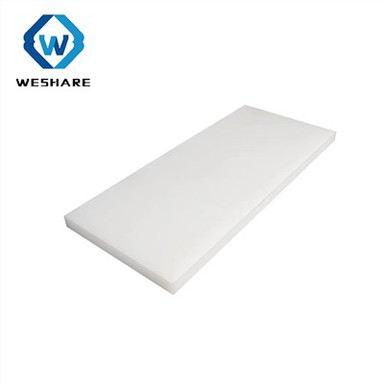
PVDF Material Sheet
PVDF sheets are made of polyvinylidene fluoride, which is a sturdy and versatile material known for its exceptional chemical resistance, UV resistance, and ability to withstand extreme temperatures. These sheets are commonly used in various industrial, architectural, aeronautical, and medical...
- Fast Delievery
- Quality Assurance
- 24/7 Customer Service
Product Introduction
PVDF (polyvinylidene fluoride) sheet is a high-performance engineering thermoplastic that combines exceptional chemical resistance, UV stability, mechanical strength, and broad temperature tolerance in a single material. With a continuous use temperature range of -40°C to 140°C and short-term capability down to -200°C, PVDF sheets outperform most common plastics - including PVC, PP, and PE - in harsh chemical environments and outdoor applications.
Available in homopolymer, copolymer, and modified grades, our PVDF sheets are supplied in plain or embossed finishes and can be easily machined, welded, thermoformed, and fabricated to meet precise design requirements. The material carries a UL 94 V-0 flammability rating, is inherently UV-resistant with no need for stabilizers, and is widely specified across chemical processing, semiconductor, architectural, aerospace, and medical industries.

Key Advantages
1. Exceptional Chemical Resistance PVDF resists virtually all inorganic acids, salts, alkalis, halogens, and aliphatic hydrocarbons at room and elevated temperatures. It is the material of choice for chemical storage tanks, piping, valve linings, and laboratory equipment where metal alloys corrode and standard plastics degrade.
2. Outstanding UV & Weather Resistance Inherently UV-stable - no stabilizers or coatings required. PVDF sheets maintain their mechanical properties and appearance after decades of outdoor exposure, making them the standard for architectural cladding, roofing membranes, and outdoor signage in aggressive climates.
3. Broad Temperature Range Performs reliably from cryogenic conditions (-200°C short-term) to continuous service at 140°C. The material retains strength and chemical resistance across the full range - far exceeding PVC, PP, and HDPE in high-temperature chemical service.
4. High Mechanical Strength Tensile strength of 50 MPa, flexural strength of 80 MPa, and excellent impact toughness (252 kJ/m²) - PVDF sheets withstand physical stress, impact, and abrasion in demanding industrial environments.
5. Excellent Electrical Insulation Volume resistivity exceeding 10¹³ Ω·cm and dielectric strength of 22 kV/mm make PVDF an effective insulator for electrical and electronic components - even in chemically aggressive or high-humidity environments.
6. Inherent Flame Retardancy UL 94 V-0 rated without halogenated additives - self-extinguishing and low smoke emission. Suitable for applications where fire safety is critical.
7. Easy Fabrication Can be machined, welded, thermoformed, injection molded, and extruded using standard thermoplastic processing equipment. Melting point around 170°C enables efficient forming and joining.
8. Low Maintenance Smooth, non-porous surface resists fouling, bacterial growth, and staining. Easy to clean, low permeability to gases and liquids, and self-lubricating for wear applications.

Technical Specifications
| Property | Standard | Value |
|---|---|---|
| Density | ISO 1183 | 1.8 g/cm³ |
| Tensile Strength | ISO 527 | 50 MPa |
| Tensile Strain at Yield | ISO 527 | 9% |
| Ultimate Tensile Strength | ISO 527 | 46 MPa |
| Ultimate Tensile Strain | ISO 527 | 80% |
| Flexural Strength | ISO 178 | 80 MPa |
| Impact Resistance | ISO 179 | 252 kJ/m² |
| Notched Impact Toughness | ISO 179 | 22 kJ/m² |
| Rockwell Hardness | ISO 2039-1 | 80 MPa |
| Shore D Hardness | DIN 53505 | 78 |
| Coefficient of Friction | DIN 53375 | 0.34 |
| Dielectric Strength | VDE 0303 | 22 kV/mm |
| Dielectric Constant | DIN 53483 | 7.25 |
| Dissipation Factor | DIN 53483 | 0.18 |
| Volume Resistivity | VDE 0303 | > 10¹³ Ω·cm |
| Surface Resistivity | VDE 0303 | > 10¹⁴ Ω |
| Comparative Tracking Index (CTI) | DIN 53480 | KC 300 |
| Water Absorption | DIN 53495 | 0.04% |
| Continuous Use Temperature | - | -40°C to +140°C |
| Flammability Rating | UL 94 | V-0 |

Available Grades
| Grade | Characteristics | Typical Applications |
|---|---|---|
| Homopolymer | Highest mechanical strength and chemical resistance | Chemical processing equipment, piping, tanks |
| Copolymer | Improved flexibility and impact resistance | Wire and cable jacketing, films |
| Modified | Enhanced processability and specific properties | Specialty molding, composite applications |
Applications
Chemical Processing - storage tanks, vessel linings, piping, valves, pump housings, fume hoods
Semiconductor - high-purity chemical distribution, wet bench components, wafer carriers
Architectural - building cladding, roofing membranes, façade panels, expansion joints
Aerospace - fuel line insulation, cable jacketing, interior paneling
Medical & Laboratory - chemical-resistant labware, fluid handling components
Oil & Gas - downhole cable insulation, flexible riser linings, chemical injection lines
Electrical & Electronics - wire insulation, cable jacketing, connector bodies
Water Treatment - membrane supports, chemical dosing components


FAQ
1. What is PVDF and how does it compare to PTFE?
PVDF (polyvinylidene fluoride) offers higher mechanical strength and easier fabrication than PTFE, while retaining excellent chemical resistance and UV stability. PTFE has a higher continuous use temperature (260°C vs. 140°C) and lower coefficient of friction, but is significantly more expensive and harder to process. PVDF is the practical choice for most chemical and architectural applications.
2. What is the maximum continuous use temperature?
PVDF sheets are rated for continuous use from -40°C to +140°C. Short-term exposure to temperatures as low as -200°C is acceptable.
3. Can PVDF sheets be welded?
Yes. PVDF is readily weldable using hot gas, butt fusion, and extrusion welding techniques - commonly used for fabricating chemical tanks and piping systems.
4. Is PVDF FDA-compliant?
Yes. PVDF is approved for food contact applications under FDA regulations. It is commonly used in food processing equipment.
5. What chemicals can attack PVDF?
PVDF is resistant to most chemicals, but is attacked by hot concentrated sulfuric acid, strong alkalis at elevated temperatures, and certain polar solvents (such as acetone, DMF, and NMP). Contact us with your specific chemical exposure for a compatibility assessment.
6. Is PVDF recyclable?
PVDF is a thermoplastic and can be reprocessed through standard regrind and remelting methods. However, recycling infrastructure for fluoropolymers is limited.
7. What sheet sizes and thicknesses are available?
Custom sizes and thicknesses are available. Contact us with your requirements.
Hot Tags: pvdf material sheet, China, suppliers, wholesale, buy, price