


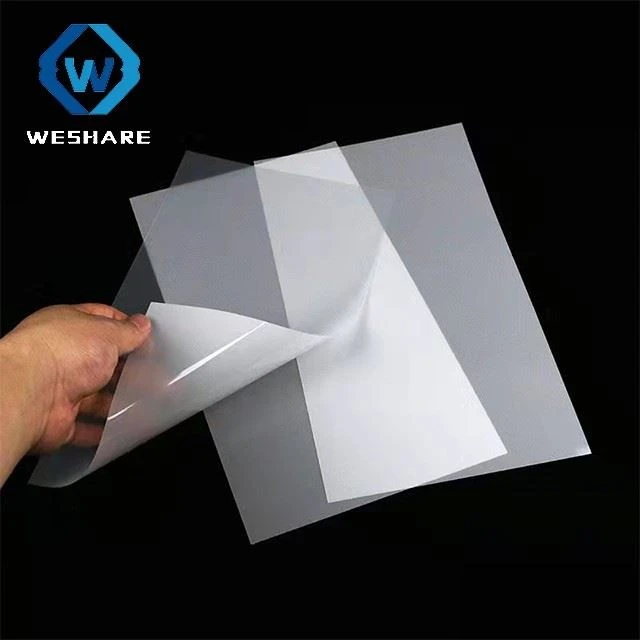
Silicone Coated Polyester Release Film
This is a polyester (PET) film with a silicone release coating, supplied as a carrier and liner for die-cutting and electronic component manufacturing. It is not a packaging film, and it is not a barrier film — its job is to hold an adhesive, a green sheet or a coated layer through a process, then release cleanly at exactly the right force, without leaving silicone behind and without shedding a particle. The two things that make PET the right substrate here are dimensional stability — PET does not stretch under web tension, so die-cut registration holds over a long run — and caliper consistency, which is what keeps kiss-cutting from cutting through the liner. Thickness: 19 – 125 µm (full band: 12 / 19 / 23 / 25 / 30 / 36 / 38 / 50 / 70 / 75 / 100 / 125 µm) Coating: silicone, single or double sided · solvent-based, solventless or fluorosilicone Options: antistatic (single or double sided) · matte · coloured (transparent, red, blue, white, black, green) Roll: width 100 – 1,200 mm · length 200 – 8,000 m · core 3" or 6", paper / PE / ABS Sheet: 200 × 200 mm to 1,000 × 1,000 mm Cleanroom: coated and converted in a controlled environment
- Fast Delievery
- Quality Assurance
- 24/7 Customer Service
Product Introduction

What This Film Is
It is a process carrier and liner. In die-cutting and electronics it does four jobs:
Protects the adhesive while the adhesive is being coated, laminated, printed and die-cut
Carries the web through the press, providing the dimensional stability the facestock lacks
Releases at a controlled force, so the die-cutter or the end applicator can separate the layers predictably
Stays clean - no silicone migration into the adhesive, no particulate onto the part
What it is not: a moisture or chemical barrier. The silicone coating controls release; it does not block moisture or chemicals. If you need a barrier layer, that is a different construction. You will see "excellent barrier against moisture and chemicals" written on generic release film pages - ignore it, and be sceptical of the supplier who wrote it.
Why PET, Not Paper, for Die-Cutting
| Property | PET release film | Release paper |
|---|---|---|
| Dimensional stability under tension | Excellent - does not stretch, so registration holds across the run | Paper stretches; registration drifts on long or fast runs |
| Caliper consistency | Very tight, and stable through humidity changes | Varies with moisture content |
| Thickness range | Down to 12 – 19 µm | Practical minimum far higher |
| Kiss-cutting reliability | High - consistent thickness means the blade can be set precisely | Paper thickness variation causes cut-through or non-cut |
| Particulate / fibre shedding | No fibre - a polymer film | Paper fibres shed at slit edges |
| Optical inspection | Transparent; vision systems can register through it | Opaque |
| Die-cutting speed | High | Limited by web strength |
Practical rule: if your process involves kiss-cutting, tight registration, thin liners, high press speed, or a vision system, specify PET film. Paper is fine where the liner is only a protective cover and no precision is required.
The Six Specifications That Decide a Die-Cutting Film
Caliper and its tolerance
Too much variation and kiss-cutting either cuts through the liner or fails to cut the adhesive
Release force (gf/25 mm, with test method and tape named)
Too light gives label/web fly; too heavy gives web break on stripping
Subsequent adhesion (% of control)
Silicone transfer kills the adhesive's tack - discovered weeks later at the customer
Antistatic / surface resistivity (Ω/sq)
Static attracts dust onto optical and electronic parts, and risks ESD damage
Cleanroom class and particulate
Particles on the liner become particles inside the assembled device
Web handling - roll tension, splice count, curl, slit edge quality
Telescoping, curl and splices stop automatic lines


Antistatic and ESD: Why Static and Dust Ruin Electronic Parts
In electronics die-cutting, static is not a nuisance - it is a yield problem, and it works in two ways:
1. Dust attraction. A charged liner pulls airborne particles onto the surface. For optical films, display components and any part with a visible surface, that dust becomes a defect that cannot be cleaned out after lamination. This is precisely why antistatic release film is specified for die-cutting optical components and for protecting the inner adhesive in tape die-cutting.
2. ESD damage. A static discharge into a sensitive component damages or degrades it - often in a way that passes final test and fails in the field.
Surface resistivity ranges you can specify (measured in Ω/sq; confirm the target against your own ESD control plan - ANSI/ESD S20.20 or IEC 61340-5-1):
| Classification | Surface resistivity | Behaviour |
|---|---|---|
| Conductive | < 10⁵ Ω/sq | Rapid charge dissipation |
| Static dissipative | 10⁵ – 10¹² Ω/sq; commonly specified 10⁶ – 10⁹ Ω/sq | Controlled, safe dissipation |
| Antistatic | ~ 10¹⁰ – 10¹² Ω/sq | Suppresses charge generation |
| Insulating | > 10¹² Ω/sq | Charge retention - not suitable for ESD-sensitive areas |
Our options: single-sided or double-sided antistatic treatment, on transparent, blue or white film, with the resistivity value stated on the batch report. Tell us your target range - "antistatic" on its own is not a specification.
Choosing Film Thickness
| Thickness | Typical use | Note |
|---|---|---|
| 12 – 19 µm | Ultra-thin liners; tight-wound rolls; optical and display | Thin liners demand tight caliper control |
| 23 – 25 µm | Thin label and tape liners; optical film liners | Common standard for precision work |
| 30 – 38 µm | General die-cut tape and foam carriers | Widely used general-purpose band |
| 50 µm | General purpose; good stiffness-to-cost balance | - |
| 70 – 75 µm | Foam tape and heavier adhesive constructions | Better registration on deep die-cuts |
| 100 – 125 µm | Heavy-duty carriers; thick foam or adhesive; where the liner must support the web | Highest rigidity |

Electronics Applications
| Application | What the film does | What to specify |
|---|---|---|
| Die-cut adhesive components (double-sided tape, foam tape, thermal pads, masking tape) | Carrier liner holding the adhesive through coating, lamination and die-cutting | Caliper tolerance, release force, subsequent adhesion, splice count |
| Optical component die-cutting | Protects adhesive and prevents dust pick-up on the optical surface | Antistatic, cleanroom class, no interference pattern, low particulate |
| FPC (flexible printed circuit) manufacturing | Carrier and protective liner during lamination and processing | Dimensional stability, thermal stability, clean release |
| MLCC / LTCC green-sheet casting | Carrier film onto which ceramic slurry is cast and dried, then released cleanly | Smoothness, uniform thickness, dimensional stability at drying temperature, clean release with no residue |
| Wafer / UV dicing tape liner | Release liner on dicing tape; must release after UV exposure without residue | Release force after UV, no silicone transfer, cleanliness |
| Protective film liners (display, touch panel, window film) | Liner on the protective film, peeled by the end user | Light release force, clarity, antistatic |
| Anisotropic conductive film and bonding sheets | Carrier through lamination | Caliper consistency, thermal stability, release consistency |
The MLCC/LTCC casting case is the most demanding. The slurry is cast directly onto the film and dried; the film must stay dimensionally stable through the drying oven, release the green sheet cleanly, and leave no residue - because residue becomes a defect in the fired component. If this is your process, send us the casting and drying conditions and we will match the grade.
Release Force: The Number Behind Every Die-Cutting Fault
"Excellent release properties" is not a specification. Release force is a number, and both directions of error are expensive on a die-cutting line.
| Failure | Cause | What you see |
|---|---|---|
| Web fly / label fly | Release force too light | Facestock lifts off the liner on the press; labels detach in the applicator |
| Web break on stripping | Release force too heavy | The skeleton does not strip cleanly; the web tears; the line stops |
| Adhesive deadening | Silicone migration | The label will not stick at the customer - discovered weeks later |
| Registration drift | Liner stretching or tension variation | Cut positions wander across the run |
Require release force with three things attached: the value, the unit (gf/25 mm or cN/25 mm), the test method (FINAT FTM 3 low speed, or FTM 10 for speed closer to real converting) and the test tape used. A number without those is not comparable between suppliers.
Also require subsequent adhesion (FINAT FTM 4) - expressed as a percentage of a control. This is the test that detects silicone transfer into the adhesive, and it is the failure mode customers blame on your adhesive rather than on the liner.
Specify release force after ageing if you hold stock. Release force drifts with time, temperature and humidity; on a warm warehouse shelf it can move measurably. If your material is held for months, the as-produced number is not the number your line will see.

Cleanroom, Particulate and Appearance
1. Cleanroom class of coating and converting. The film should be coated and slit in a controlled environment, with the class stated - for example, processed in a 1,000-class (ISO 6) cleanroom.
2. Particulate and slip agents. No fibre shedding (an inherent PET advantage over paper), and no loose particulate at slit edges. Ask for the slit-edge condition to be specified.
3. Optical appearance - the "rainbow" problem. Interference patterns, coating streaks, wrinkles, scratches and bubbles all affect vision-system registration and optical inspection. Specify uniform coating, no interference (rainbow) pattern, no wrinkles, scratches or bubbles. This is standard practice in this product family and should be on your page as a stated quality criterion, not left implicit.
FAQ
Is a PET release film suitable as a moisture barrier?
No. The silicone coating controls release, not moisture transmission. If you need a barrier, specify a barrier construction - do not rely on a release liner.
Why choose PET film instead of release paper for die-cutting?
PET does not stretch under web tension and its caliper is far more consistent, so die-cut registration holds across a long run and kiss-cutting can be set precisely. Paper also sheds fibre at slit edges.
Which thickness should I use?
For general tape and foam die-cutting, 30 – 50 µm is a common starting point. For optical and thin liner work, 19 – 25 µm. For heavy foam or deep die-cuts, 75 – 125 µm. Tell us your die-cut geometry and press and we will recommend.
What release force do you supply?
It is selectable and agreed against your test method and test tape.
Do not accept "easy release" as an answer from any supplier: release force that is too light causes web fly, too heavy causes web break.
How do I know the silicone will not migrate into my adhesive?
Require subsequent adhesion to FINAT FTM 4. A result close to 100 % of control indicates no meaningful transfer. Under-cured coating is the usual root cause, which is why we test cure on every batch.
Do you supply antistatic film?
Yes - single or double sided antistatic treatment, on transparent, blue and white film. Tell us your target Ω/sq range and the value will be stated on the batch report.
Can the film be used for MLCC or LTCC green-sheet casting?
Yes, and this is one of the most demanding uses. Send us your casting and drying conditions - the film must stay dimensionally stable through the oven and release the green sheet with no residue.
Can I get a sample roll for a trial?
Yes. For die-cutting and electronics work we recommend a trial roll rather than a flat sample, because the behaviour that matters only appears under web tension on your own equipment.


Hot Tags: silicone coated polyester release film, China, suppliers, wholesale, buy, price, Release Paper, Silicone Coated PET Release Film


