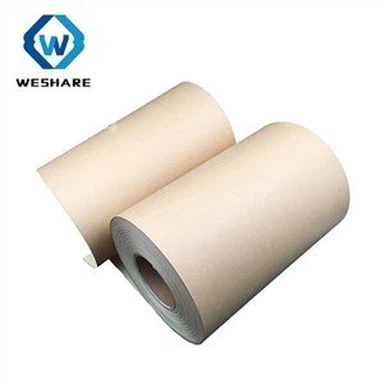
Electrical insulating paper for motors and transformer
Electrical insulating paper is the material placed between conducting parts in motors, generators and transformers so that current stays where it is meant to go. Weshare supplies the full range: plain cellulose papers such as cable paper and crepe paper, epoxy-coated papers such as DDP, laminated composites such as DMD, NMN, NHN, AMA and AHA, high-frequency PMP paper, and vulcanized fibre fish paper. The right choice is decided by three things: the thermal class of the equipment, whether the insulation will be in contact with transformer oil, and whether the part has to be punched or formed to shape. The table below sets out how the families differ. If you send us the application, we will tell you which one fits — including when the answer is that the part should be made from a different material altogether.
- Fast Delievery
- Quality Assurance
- 24/7 Customer Service
Product Introduction
Products Description

Insulation paper is not one material but a family, and the failure mode is always the same: the paper is chosen for the wrong thermal class or the wrong environment, works for a few months, and then breaks down. Choosing correctly starts with three questions.
1. What is the thermal class of the equipment?
Insulating paper is rated by the maximum continuous temperature it can survive. Class A (105 °C), Class B (130 °C), Class F (155 °C) and Class H (180 °C) are the common grades. A paper rated below the equipment class will age rapidly and lose dielectric strength. Plain cellulose papers sit at Class A; adding a polyester film lifts the rating to B or F; adding a polyimide film reaches Class H.
2. Will the insulation contact transformer oil?
This is where most specification errors happen. Cellulose papers such as cable paper and DDP are designed for oil-immersed transformers and are compatible with transformer oil. Vulcanized fibre (fish paper) is not: it absorbs oil, swells and loses dielectric strength. Composites with a film layer depend on their construction and should be confirmed per grade.
3. Does the part have to be cut or formed to shape?
Slot insulation and gaskets are usually punched or die-cut, and the material has to hold a clean edge and keep its shape. Vulcanized fibre and the film composites handle this well; plain thin papers do not. Once those three questions are answered, the material family follows from the table below. Weshare supplies all of them, so we can recommend without steering you toward whatever happens to be in stock.

Detail
| Family | Structure | Thermal class | Oil-immersed duty | Key property | Typical use |
|---|---|---|---|---|---|
| Cable paper | 100 % sulfate wood pulp | Class A (105 °C) | Yes | Low cost, oil compatible | Oil-immersed transformer windings, layer insulation |
| Crepe paper | Creped cellulose paper | Class A (105 °C) | Yes | Stretchable, conforms to curves | Coil insulation, oil-filled equipment |
| DDP | Kraft paper + epoxy resin dots | / | Yes | Bonds on curing, diamond coating | Oil-immersed power transformer interlayer and turn insulation |
| DMD | Polyester film + polyester non-woven | Class B (130 °C) | / | Mechanical + dielectric balance | Y-series motor slot, inter-turn and inter-layer insulation |
| DMD-F (6641) | Polyester film + electrical non-woven both sides | Class F (155 °C) | / | Higher-rated DMD | Class F motor slot and phase insulation |
| NMN | Meta-aramid paper + PET film + meta-aramid paper | Class F (155 °C) / H (180 °C) | / | Aramid surface heat resistance + film dielectric strength | Motor slot, turn and liner insulation; transformers and reactors |
| NHN | Meta-aramid paper + polyimide film + meta-aramid paper | Class H (180 °C) | / | Highest combined thermal and dielectric rating | Class H motor slot insulation, high-temperature transformers |
| AMA | Aramid paper + PET film + aramid paper | Class F [?] | / | Lower-cost route to aramid-surface insulation | Motor slot and inter-layer insulation |
| AHA | Aramid paper + polyimide film + aramid paper | Class H (180 °C) | / | Smooth surface for automatic insertion lines | Low-voltage motor slot, slot cover and phase insulation |
| PMP | Polymethylpentene paper | / | / | Very low dielectric loss at high frequency | High-frequency transformers, communication equipment |
| Fish paper | Vulcanized fibre (cellulose, no film) | Class A / E |

FAQ
Q: What is the difference between insulating paper and insulation paper?
Both terms are used for the same family of materials - electrical-grade papers and paper-film composites used to insulate motors, generators and transformers. The distinction that matters is not the name but the thermal class and whether the material is oil compatible.
Q: How do I choose the right thermal class?
Match the paper's class to the equipment's class with margin: Class A (105 °C) for standard oil-immersed transformers, Class B (130 °C) for DMD in small and medium motors, Class F (155 °C) for DMD-F and NMN, and Class H (180 °C) for NHN and AHA. Undersizing the class is the most common cause of premature insulation failure. Send us the equipment class and we will confirm the correct grade.
Q: Which insulating papers can be used in oil-immersed transformers?
Cable paper, crepe paper and DDP are designed for oil-immersed duty. Fish paper (vulcanized fibre) must not be used in oil - it absorbs oil and moisture, swells, and loses dielectric strength over time. Film composites depend on their construction; confirm the specific grade.
Q: What is the difference between NMN and AMA, or NHN and AHA?
The naming describes the layer stack. NMN and NHN use meta-aramid paper on both faces; AMA and AHA use aramid paper on both faces. The middle layer decides the thermal class: a polyester film (Mylar) gives Class F, a polyimide film gives Class H. Confirm the exact construction of the grade you are ordering with our sales engineer.
Q: Can you supply custom thickness, width and slitting?
Yes. Thickness, width, thermal grade and slitting are all available to order. Standard roll widths are 980–1000 mm for most composites; tapes can be slit from 5 mm. Send the application and the required dimensions and we will quote.
Q: Do you provide test reports?
A quality inspection sheet is issued with every batch, covering thickness, tensile strength, breakdown voltage and adhesion as applicable to the grade.
our certificate

Hot Tags: Electrical insulating paper for motors and transformer, China, suppliers, wholesale, buy, price