
Oil Filter Media
Multi-layer wet-process oil filter media with gradient fibre design for high efficiency, low resistance and long service life in engine and industrial lubrication systems.
- Fast Delievery
- Quality Assurance
- 24/7 Customer Service
Product Introduction
Oil Filter Media for Engine and Industrial Lubrication Systems
Lubricating oil filtration has a different economics from fuel or intake filtration. The oil is not consumed - it circulates. Every particle the filter misses stays in the sump and is presented to the filter again, and to the bearings, the turbocharger and the piston cooling jets, thousands of times over the drain interval. Wear particles also generate more wear particles, so a filter that removes 90% of the fine fraction instead of 98% does not degrade linearly; it degrades the whole system's wear rate.
The requirement that follows is unusual: high efficiency and low resistance at the same time, held over a long service life. A single uniform pore structure cannot do all three. A gradient structure can.
The gradient design
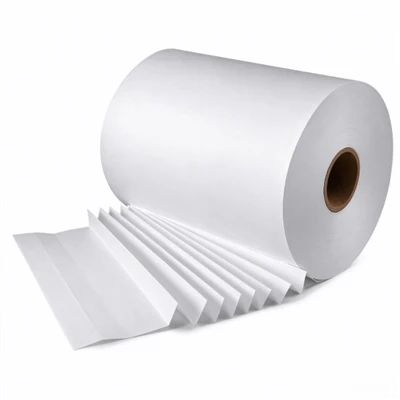
Our oil filter media is produced by a multi-layer wet process using high-quality fibre raw materials. Instead of one homogeneous sheet, the media is built with a deliberate pore gradient through its thickness:
The upstream layer is more open - it accepts the bulk contaminant load and holds it in the depth of the structure rather than as a surface cake.
The downstream layers are progressively finer - they perform the final capture on the particles that matter for bearing and turbo protection.
Two things follow. First, capacity goes up, because the load is distributed through the depth instead of blinding the face. Second, restriction stays low for a given efficiency, because the flow is not forced through a single tight barrier. Third, service life extends, because the element is not choked by a surface cake in the first 20% of its interval.
This is what allows us to meet technically demanding customer requirements in different applications - high efficiency, low resistance, and long service life are specified as a combination rather than traded off one against another.
The bonding system
The grades are bonded with a specially developed latex compounding system. This matters more than it sounds:
Non-curing behaviour. A curing resin continues to crosslink after the sheet leaves the treater, so stiffness drifts with time and storage. A non-curing bond holds its specified stiffness, which means the pleat height a converter sets on day one is the pleat height six months later.
Low volatility. Volatile components in a binder can outgas inside a sealed oil filter, contribute to odour, and interact with the oil's additive package. Low volatility keeps the media chemically quiet in service.
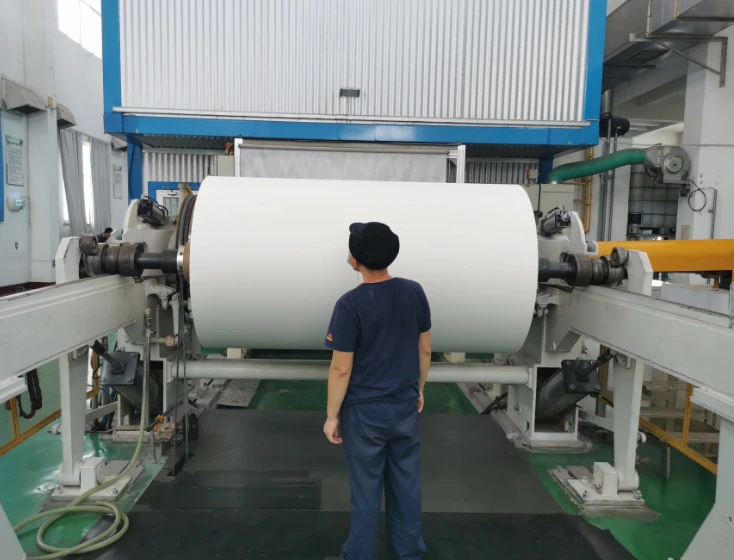
For a filter-maker running automated pleating and end-cap potting, non-curing and low volatility are quality-control properties as much as performance properties.
Grade data
| Grade | Basis weight (g/m²) | Thickness (mm) | Corrugation depth (mm) | Air permeability @200 Pa (L/m²·s) | Max pore size (µm) |
|---|---|---|---|---|---|
| HTG1180 | 150 | 0.60 | 0.25 | 110 | 50 |
| HTG2145 | 145 | 0.60 | 0.25 | 360 | 80 |
| HTJ2200 | 200 | 0.75 | 0.25 | 550 | 100 |
| HTJ3156 | 150 | 0.58 | 0.25 | 570 | 110 |
| HTJ1135 | 135 | 0.52 | 0.25 | 585 | 105 |
Grade selection
HTG1180 - the fine, high-efficiency grade. 110 L/m²·s with a 50 µm maximum pore at 0.60 mm. Specify it for full-flow engine oil filtration where the fine fraction matters - turbocharged engines, extended drain intervals, and any application where the OEM's cleanliness target is aggressive.
HTG2145 - the balanced fine grade. 360 L/m²·s and 80 µm. A practical compromise where the pump's relief setting limits allowable restriction but fine capture is still required.
HTJ2200 - the heavy-duty capacity grade. 200 g/m² at 0.75 mm, 550 L/m²·s, 100 µm. High basis weight gives depth for dirt holding; use it on high-soot applications and large-sump industrial engines.
HTJ3156 - the thin high-flow grade. 150 g/m², 0.58 mm, 570 L/m²·s, 110 µm. Suited to bypass filtration and to pre-filter stages.
HTJ1135 - the most open grade. 585 L/m²·s at 135 g/m². Bypass elements, kidney-loop filtration on hydraulic reservoirs, and high-flow industrial lube circuits.
Applications
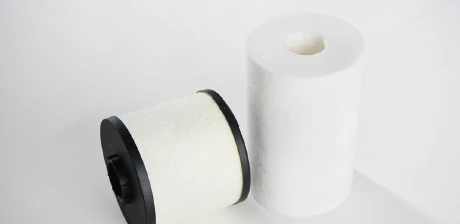
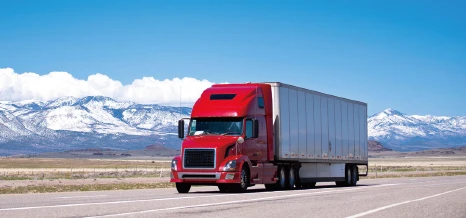
- Full-flow and bypass engine oil filters - passenger car, truck, off-highway
- Industrial engine lubrication systems - gensets, compressors, pumps
- Gearbox and transmission oil filtration
- Hydraulic reservoir kidney-loop and offline filtration
- Turbine and machine-tool lube oil circuits
Why "efficiency, resistance, life" is a real design claim
Consider two media with the same 4 µm efficiency. If one achieves it with a uniform tight pore and the other with a gradient structure, the first will show higher initial restriction and load faster; the second will hold lower restriction longer because the dirt is distributed. Over a full drain interval the second media passes more oil at lower average restriction and holds more contaminant - the element reaches its restriction limit later, not earlier. That is the mechanism behind the three-way claim, and it is measurable on a multi-pass bench.
Converting and supply format
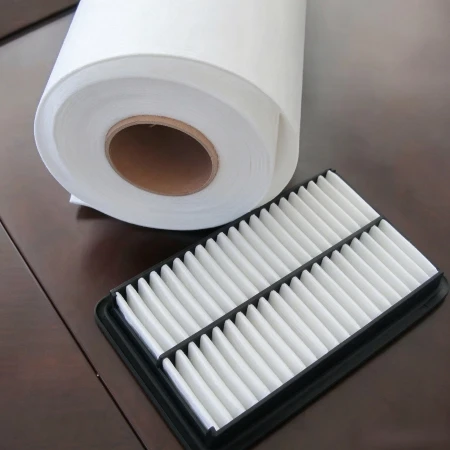
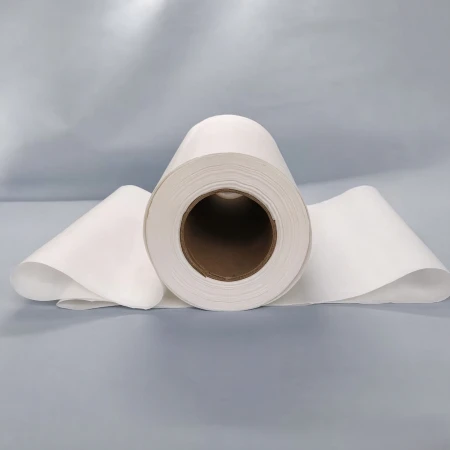
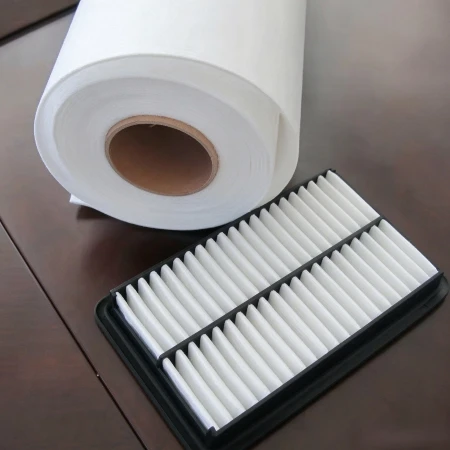
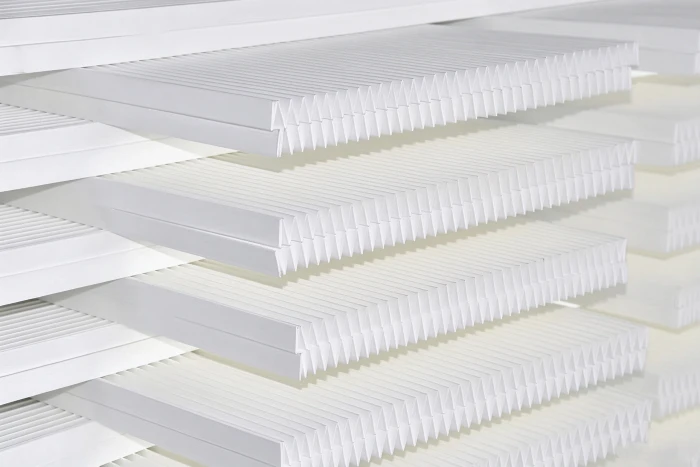
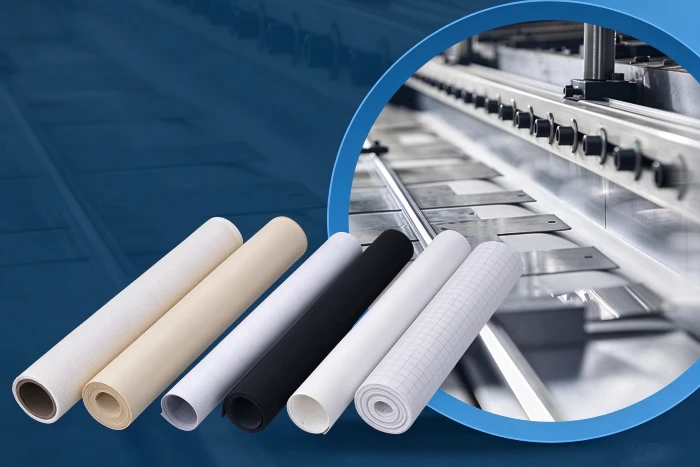
Rolls slit to pleater width; corrugation at 0.25 mm across the range.
Non-curing latex bond means no post-treat cure drift - the sheet can be stored and pleated without re-qualifying stiffness.
Thickness tolerance held tight, since 0.02 mm of drift changes pleat height and end-cap fit.
Grades can be supplied flat for customers with in-house corrugation.
FAQ
What is a "gradient" filter media in practice?
A sheet whose pore size decreases from one face to the other, created by depositing progressively finer fibre layers in a multi-layer wet process. The dirt loads through the depth instead of on the surface.
Is non-curing bonding weaker than a cured resin?
No. Non-curing refers to the absence of post-treatment crosslinking, not to a lower bond strength. It means the delivered stiffness is the final stiffness.
Why does low volatility matter inside an oil filter?
Because anything volatile that leaves the media ends up in the oil or in the headspace of a sealed element. Low volatility keeps the media from contributing to oil degradation or odour.
Can HTG1180 replace a competitor's high-efficiency lube media?
Send basis weight, thickness, permeability and the OEM cleanliness target. HTG1180 is the closest match to a fine full-flow specification; where the restriction budget is tighter we would look at HTG2145.
Do you supply media for both full-flow and bypass elements?
Yes - HTG1180 and HTG2145 for full-flow, HTJ1135 and HTJ3156 for bypass and offline circuits.
Ordering note: MOQ, roll dimensions and lead time are confirmed per grade.
Hot Tags: oil filter media, China, suppliers, wholesale, buy, price
No Information