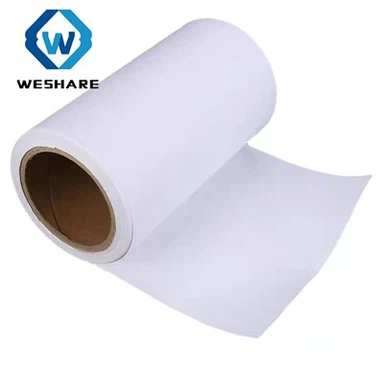
Common Problems in Transfer Process and How Transparent Release Film Solves Them
Jan 15, 2026

In label, graphic, and industrial transfer applications, transfer failures often result in material waste, rework, and reduced production efficiency. Many of these issues are not caused by printing equipment or operators, but by the selection of an unsuitable transfer carrier material.
This article reviews the most common problems encountered in transfer processes and explains how transparent release film helps address these challenges.
Problem 1: Inaccurate Positioning and Misalignment
The Issue
Misalignment occurs when labels or graphics are placed unevenly, skewed, or offset from their intended position. This problem is especially common with:
Small labels
Complex graphics
Multi-layer transfers
Opaque or paper-based carriers make it difficult to see alignment references during positioning.

How Transparent Release Film Solves It
Transparent release film allows operators to:
See substrate edges and reference marks clearly
Adjust placement before transfer
Achieve accurate and repeatable positioning
This visibility significantly reduces placement errors and improves first-pass yield.

Problem 2: Residue and Surface Contamination After Release
The Issue
Some transfer materials leave behind:
Adhesive residue
Paper fibers
Dust or particles
These contaminants can affect both the appearance and adhesion performance of the transferred graphic.
How Transparent Release Film Solves It
PET-based transparent release film with a controlled release coating provides:
Clean separation during release
Minimal surface residue
Reduced contamination risk
This results in a cleaner finished surface and fewer post-transfer defects.
Problem 3: Film Deformation During Processing
The Issue
Transfer carriers may stretch, wrinkle, or shrink during:
Printing
Lamination
Handling under tension
Deformation leads to distorted graphics and inconsistent transfer results.
How Transparent Release Film Solves It
PET-based transparent release film offers:
High dimensional stability
Low elongation under tension
Stable performance during processing
This stability helps maintain graphic integrity throughout the transfer process.
Problem 4: Inconsistent Release Performance
The Issue
Inconsistent release force can cause:
Partial transfer
Tearing of graphics
Uncontrolled separation
This issue is often amplified in bulk production when batch consistency is poor.
How Transparent Release Film Solves It
High-quality transparent release film is engineered with:
Uniform release coating
Controlled and stable release force
Reliable batch-to-batch consistency
This ensures predictable release behavior across large production runs.
Problem 5: Low Efficiency in Mass Production
The Issue
Frequent rework, repositioning, and quality checks slow down production and increase labor costs.
How Transparent Release Film Solves It
By improving:
Positioning accuracy
Release consistency
Overall transfer reliability
transparent release film helps reduce scrap rates and supports smoother, faster production flow.
Problem 6: Incompatibility With Printing or Transfer Processes
The Issue
Some carrier materials do not perform well across different printing or transfer methods, leading to inconsistent results.
How Transparent Release Film Solves It
Transparent release film is compatible with:
Screen printing
Heat transfer printing
Graphic lamination processes
Its surface and thermal stability allow it to adapt to various production environments.
Why Material Selection Matters More Than Equipment
Many transfer problems are mistakenly attributed to machinery or operator skill. In reality, carrier material selection plays a critical role in overall transfer performance.
Choosing the right transparent release film can:
Improve product quality
Reduce waste
Increase production efficiency