

Glassine Release Paper: The Essential Liner for Hot Melt Adhesive Film Production
Apr 17, 2026
Glassine Release Paper: The Essential Liner for Hot Melt Adhesive Film Production
In the hot melt adhesive film (HMAF) manufacturing process, the release liner is far more than a auxiliary material-it is a critical factor that directly determines coating uniformity, production efficiency, and the final performance of the finished adhesive film. Choosing the right release liner can significantly reduce production defects and optimize overall operational costs.
Among the various liner materials available in the market, glassine release paper stands out as the most cost-effective and stable choice for most hot melt adhesive film applications. Its unique combination of smoothness, heat resistance, and controlled release properties makes it the preferred option for industrial-scale HMAF production worldwide.
What Is Glassine Release Paper?
Glassine release paper is a high-performance liner material made by super-calendering high-density base paper, followed by a precise silicone coating. This silicone layer is key to its core function-providing consistent, controlled release properties that allow the hot melt adhesive film to separate cleanly from the liner without damage or residue.
Key Characteristics of Glassine Release Paper
Ultra-smooth surface: Ensures even contact with the hot melt adhesive during coating, avoiding unevenness or defects.
High density & tensile strength: Withstands the tension of high-speed coating, winding, and slitting processes without tearing or deformation.
Stable release force: Maintains consistent performance throughout the entire production cycle, preventing unexpected film separation or sticking.
Excellent heat resistance: Can withstand the high temperatures (120–160°C) of hot melt adhesive coating processes without yellowing or degradation.
These features make glassine release paper perfectly suited for use as a release liner in hot melt adhesive film production, addressing the core needs of industrial manufacturing.
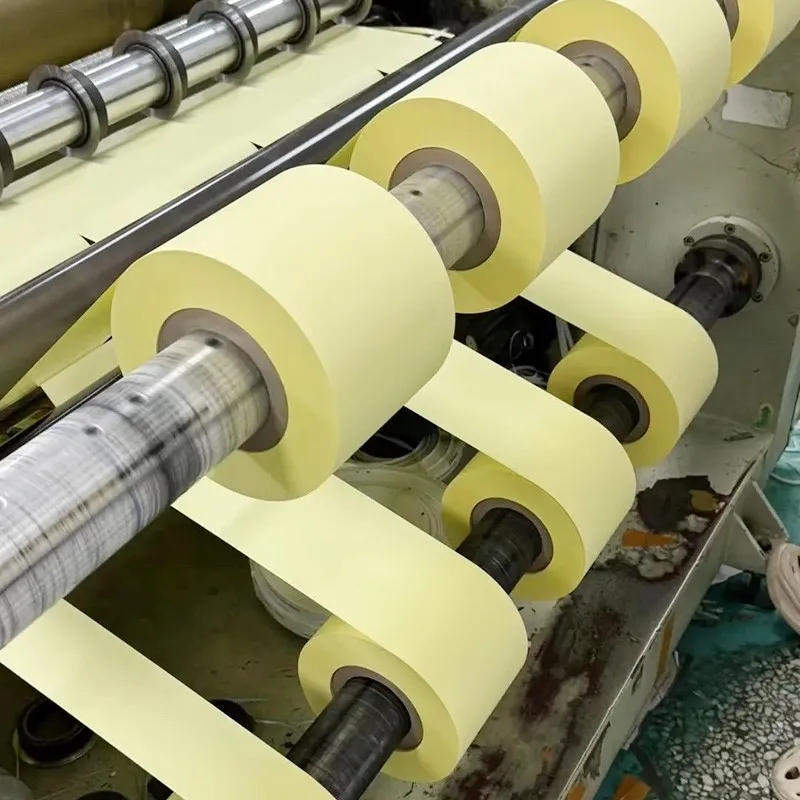
Why Glassine Release Paper Is Indispensable for Hot Melt Adhesive Film
For hot melt adhesive film manufacturers, the choice of release liner directly impacts production efficiency and product quality. Here's why glassine release paper is the go-to option:
1. Guarantees Uniform Adhesive Coating
The ultra-smooth surface of glassine release paper eliminates uneven contact points between the liner and the hot melt adhesive. This ensures:
Even distribution of the adhesive across the liner surface
Consistent thickness of the hot melt adhesive film
A defect-free finish (no bubbles, streaks, or uneven spots) on the final product
2. Delivers Stable Release Force
The production process of hot melt adhesive film involves multiple stages-coating, cooling, winding, and slitting. Unstable release force at any stage can lead to costly issues, such as:
Premature or delayed film separation from the liner
Coating defects (e.g., tearing, wrinkling of the adhesive film)
Production line shutdowns due to operational instability
Glassine release paper solves this problem by providing consistent, controlled release performance, ensuring smooth operation across all production stages.
3. Balances Performance Across All Production Stages
Different stages of hot melt adhesive film production require different release characteristics. Glassine release paper can be tailored to meet these varying needs:
|
Production Stage |
Release Force Requirement |
|---|---|
|
Coating |
Medium-high release force (prevents adhesive from flowing or sticking during application) |
|
Slitting & Transport |
Stable medium release force (ensures easy handling without film damage) |
|
Final Lamination |
Easy peel (allows clean separation of the liner from the adhesive film during end-use) |
The most commonly used release force range for hot melt adhesive film applications is 8–12 gf/25mm, which balances performance across all stages.
4. Compatible with Multiple Hot Melt Adhesive Types
Glassine release paper is highly versatile and works seamlessly with all major types of hot melt adhesive films, including:
TPU (Thermoplastic Polyurethane) hot melt adhesive film
PES (Polyester) hot melt adhesive film
PA (Polyamide) hot melt adhesive film
Additionally, the release force can be customized according to the specific adhesive system and film thickness, making it adaptable to diverse production needs.
5. Cost-Effective Alternative to PET Film Liners
While PET film liners are sometimes used for high-temperature applications, glassine release paper offers a more cost-effective solution for most hot melt adhesive film production. Compared to PET liners, glassine paper provides:
Lower material costs
Sufficient heat resistance (120–160°C) for standard coating processes
A better cost-performance ratio, reducing overall production costs without compromising quality
Key Factors to Consider When Choosing a Release Liner for Hot Melt Adhesive Film
Selecting the right release liner is critical to ensuring smooth production and high-quality finished products. Here are the key factors to evaluate:
Release Force: Must be matched to the type and thickness of the hot melt adhesive-too high, and the film will be difficult to peel; too low, and it may separate prematurely.
Surface Smoothness: Directly affects the uniformity of the adhesive coating and the final finish of the hot melt adhesive film.
Tensile Strength: Essential for high-speed coating lines, as the liner must withstand tension without tearing or stretching.
Silicone Coating: Choose single-side or double-side coating based on your production process-single-side is standard for most HMAF applications, while double-side is used for special processes or anti-blocking needs.
Temperature Resistance: Must be able to withstand the maximum temperature of your coating process (typically 120–160°C for hot melt adhesive film).
Common Issues Caused by Low-Quality Release Liners
Using low-quality or mismatched release paper can lead to a range of production problems, directly impacting product quality and operational efficiency. Common issues include:
Silicone transfer: Silicone from the liner sticks to the adhesive film, affecting its bonding performance.
Unstable release force: Causes inconsistent film separation and production disruptions.
Difficult peeling: Leads to film damage or delays in the lamination process.
Film defects: Uneven coating, bubbles, or streaks on the finished adhesive film.
Production downtime: Costly delays due to liner-related issues.
FAQ: Glassine Release Paper for Hot Melt Adhesive Film
Q: What release force is best for hot melt adhesive film?
A: For most hot melt adhesive film applications, a release force of 8–12 gf/25mm is recommended, as it balances performance across coating, slitting, and lamination stages. However, custom ranges (60–80 gf/25mm, 80–100 gf/25mm, 200–300 gf/25mm) are available to match specific adhesive types, film thicknesses, and production conditions.
Q: Is glassine paper better than PET liner for hot melt adhesive film?
A: For most standard hot melt adhesive film production, yes. Glassine release paper offers lower costs, stable performance, and smooth processing. PET liners are only necessary when higher temperature resistance (exceeding 160°C) is required for specialized applications.
Q: Should I use single-side or double-side silicone coating?
A: Single-side silicone coating is the standard choice for most hot melt adhesive film production. Double-side coating is recommended for special processes (e.g., double-sided adhesive film) or when anti-blocking properties are needed to prevent the liner from sticking to itself during winding.
Q: What grammage (basis weight) should I choose?
A: The choice of grammage depends on your application:
60gsm: Suitable for thin hot melt adhesive films and light-duty applications.
80gsm: The standard choice for most industrial hot melt adhesive film production.
90gsm: Ideal for heavy-duty industrial use, where higher tensile strength is required.
Q: Can the release force be customized?
A: Yes. Release force can be fully customized based on three key factors: the type of hot melt adhesive, the thickness of the adhesive film, and your specific production conditions. This ensures the liner perfectly matches your manufacturing process.


