Kertas Nasi: Southeast Asia's Food Wrapping Paper
Oct 01, 2026

What "Kertas Nasi" Actually Means
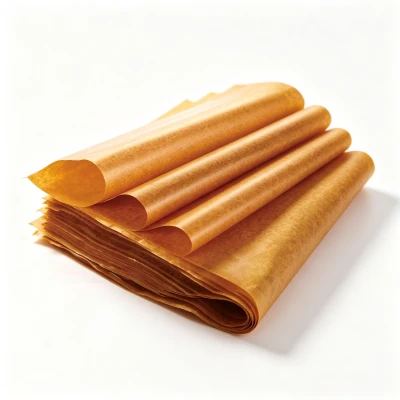
In Malay, kertas means paper and nasi means rice. Put together, Kertas Nasi is the everyday name traders, stallholders and packaging wholesalers across Malaysia, Singapore and Indonesia use for the pre-cut greaseproof food wrapping paper that wraps rice, skewers and fried snacks.
It is not decorative paper and it is not stationery. It is a working material: a thin, food-grade sheet with a grease-resistant surface, cut to a kitchen-friendly size and stacked for fast, one-hand use at the point of sale.
Two clarifications save B2B buyers a lot of confusion:
It is not edible rice paper (the type used for fresh spring rolls). That product is a totally different material. When you buy "kertas nasi" from a food packaging supplier, you are buying wrapping paper, not a food ingredient.
It comes in white and brown (kraft). Brown is the heritage look of pasar malam and warung stalls; white is preferred by restaurants and central kitchens because it photographs clean and prints cleanly.
The street-level vocabulary varies by market, and buyers should know all of it because suppliers list under different names:
| Market | What buyers call it |
|---|---|
| Malaysia | Kertas Nasi, Kertas Nasi Lemak, Kertas Bungkus Nasi, Hawker Paper, Kertas Minyak, Kertas Roti John, Kertas ABCD |
| Singapore | Hawker paper, food wrapping paper, greaseproof paper, oil paper, kertas nasi (Malay-speaking trade) |
| Indonesia | Kertas Nasi, Kertas Bungkus Nasi, Kertas Minyak |
| Thailand | กระดาษห่ออาหาร (food wrapping paper), กระดาษไข (greaseproof / wax paper), กระดาษรองอาหาร (food liner paper) |
If you are sourcing from overseas, always describe the product by function (food-grade greaseproof wrapping paper, pre-cut sheets) rather than by a single local nickname. The same sheet is sold under a dozen names across the region.
Why Southeast Asia Runs on Wrapping Paper
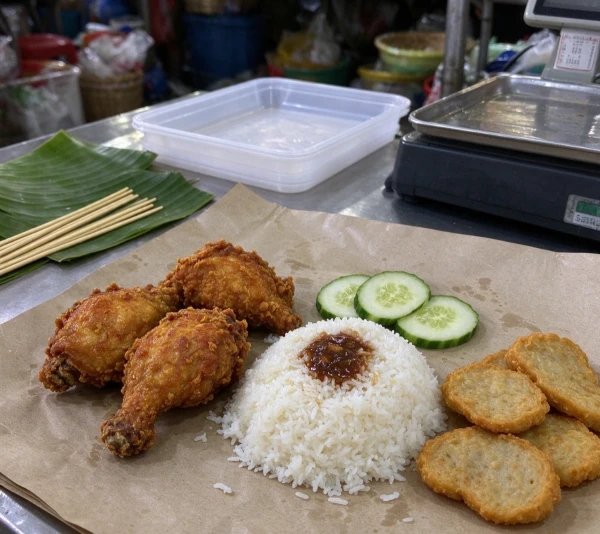
Street food is not a niche in Southeast Asia - it is the default way people eat. In Malaysia the pasar malam (night market) and the roadside warung feed millions daily. In Singapore the hawker centre is a national institution. In Thailand the talat and roadside moo ping grills operate morning to night. Every one of those transactions needs a way to hand food to a customer that is cheap, hygienic, fast and grease-tight.
The traditional answer was the banana leaf - and it is still used for premium nasi lemak and for wrapping nasi at certain stalls. But banana leaf is bulky, seasonal, variable in quality and slow to fold. Steady demand for a consistent, stackable, food-safe sheet created the modern Kertas Nasi category.
Kertas Nasi wins on four fundamentals that matter to any high-volume vendor:
Grease management. Rice dishes come with oil, sambal, curry gravy and coconut milk. A greaseproof sheet keeps the food from bleeding through onto the tray, the bag or the customer's hand.
Speed at the counter. Pre-cut sheets are pulled and folded in seconds during a lunch rush. No cutting, no sizing decisions.
Hygiene and food safety. A single-use sheet that only ever touches one portion is the cleanest option available to a stall with no dishwashing capacity.
Cost per serve. At wholesale prices, the paper is a few cents per portion - the cheapest way to make a greasy product presentable and clean.
That is why the category is not shrinking. Whether the customer is a warung in Kelantan, a hawker stall in Toa Payoh or a grilled-pork vendor in Chiang Mai, the unit economics push them toward pre-cut greaseproof sheets.
Choosing the Right Grammage
Grammage (gsm = grams per square metre) is the single most important specification, because it sets the trade-off between cost, stiffness and oil resistance. The Southeast Asian market has settled on three working grades. Match the grade to the food, not to the lowest price.
| Grade | Character | Oil resistance | Stiffness | Best for | Typically bought by |
|---|---|---|---|---|---|
| 40 gsm | Light, economical | Moderate | Soft, easy to fold | Small snacks, satay sticks, light portions, simple rice wraps | Night-market snack stalls, high-volume low-ticket vendors |
| 50 gsm (market standard) | Balanced all-rounder | Good | Firm enough to hold shape | Nasi lemak, fried chicken, satay, general fried food, tray lining | Most hawker stalls, warungs, catering suppliers |
| 60 gsm | Heavy-duty | Strong | High, stays flat on the tray | Gravy-heavy and high-oil dishes - rendang, fried chicken, grilled meats, saucy rice | Restaurants, takeaway shops, delivery kitchens |
Guidance for buyers:
Selling to many small stalls? Stock 40gsm and 50gsm. 40gsm clears volume; 50gsm is the safe default that almost never gets a complaint.
Selling to restaurants, delivery kitchens or catering? Lead with 60gsm. It is the grade that survives a saucy dish sitting in a delivery bag for thirty minutes.
Not sure what to order first? A mixed trial - one carton each of 40/50/60gsm - lets a distributor test-sell all three without committing to a slow-moving SKU.
A useful rule of thumb: the wetter and oilier the dish, the heavier the sheet. If a vendor's menu is built around sambal, curry or coconut milk, they will feel the difference between 40gsm and 60gsm within a week.
Format, Size and Packaging
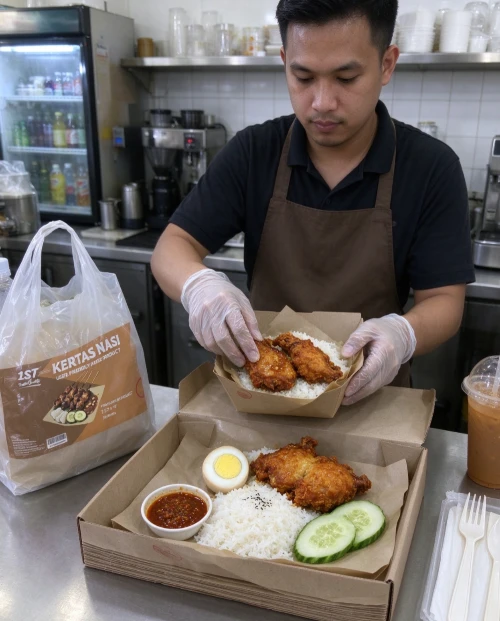
Kertas Nasi is sold almost universally as pre-cut loose sheets, not rolls - because the format is what makes it fast to use. A roll forces the vendor to estimate, tear and discard; a pre-cut sheet is grab-and-go.
Reference specification (standard export item):
Sheet size: 15.25" × 17.5" (approximately 38.7 cm × 44.5 cm)
Sheets per pack: 70 sheets
Colour: brown (kraft-look) or white
Form: interleaved, loose-cut sheets
This size is versatile by design: one sheet comfortably wraps a standard nasi lemak bundle or a portion of satay, and folds down neatly to act as a tray or basket liner for fried snacks.
Buyer checklist when ordering:
Sheet count per pack - confirm whether the pack is 50, 70 or 100 sheets; this changes your landed cost per serve more than the gsm does.
Sheet size - the 15.25" × 17.5" sheet is the regional standard, but stalls running smaller portions often ask for a smaller cut. Custom cutting is worth requesting at volume.
Colour consistency - if a vendor prints their stall name or logo, batch-to-batch colour consistency matters.
Packaging - poly-bagged packs inside an export carton protects against humidity, which is a real risk in tropical warehousing.
Gauge tolerance - request the actual measured grammage of the delivered batch, not just the nominal figure.
Custom sizes, custom sheet counts and printed/private-label sheets are all standard requests at container volumes. A distributor who can offer "the same sheet, but cut to your customer's size and printed with their logo" gains a strong reason to be reordered.
The Southeast Asia Market Guide: Country by Country
This is the part most generic product pages miss. The same sheet solves a slightly different problem in each market, and the search terms your customers actually type are in the local language. Buying is driven by the dish, the venue and the season.
5.1 Malaysia - the home of Kertas Nasi
Malaysia is the reference market. The category name itself is Malay, and the local vocabulary is the richest of any country in the region.
Local terms to rank for and to use in listings: Kertas Nasi, Kertas Nasi Lemak, Kertas Bungkus Nasi, Kertas Pembungkus Nasi Lemak, Hawker Paper, Kertas Minyak, Kertas Roti John, Kertas ABCD, Kertas Pemisah Makanan.
Core dishes: nasi lemak (the flagship use - rice in coconut milk with sambal), satay (grilled skewers, often plated on a paper liner), goreng pisang (banana fritters), roti john, fried chicken and kuih snacks.
Where it is used: pasar malam (night markets), roadside warung and gerai, kedai makan (eateries), and increasingly by delivery-pack kitchens in the Klang Valley.
Why 50gsm dominates here: nasi lemak is normally sold as a folded bundle tied or taped at the sides. The sheet must hold that fold without splitting under sambal and coconut-milk oil - which is why the market standard settled at 50gsm rather than the lighter 40gsm snack grade.
Buyer profile: wholesalers serving thousands of stalls, food-bank and event caterers, central kitchens, and packaging resellers on platforms where "hawker paper" and "kertas nasi lemak" are high-frequency search terms.
5.2 Singapore - hawker culture with premium expectations
Singapore is a compact, high-volume, English-first market with a strong hawker tradition. Buyers here tend to search in English, but the Malay terms remain in use among the food-trade community.
Local terms: hawker paper, food wrapping paper, greaseproof paper, oil paper, kertas nasi.
Core dishes: nasi lemak, satay (a classic at Lau Pa Sat and countless hawker centres), economic bee hoon, char kway teow, chwee kueh, fried snacks and carrot cake.
What is different here: Singapore buyers are more likely to want white sheets for presentation, cleaner branding, and consistent pack counts for central-kitchen operations. They also place a higher weight on documented food-contact safety, because inspections are strict and kitchens are professionalised.
Buyer profile: hawker-supply wholesalers, central kitchens, caterers, hotel F&B procurement and food-manufacturing plants.
5.3 Thailand - a packaging-literate, high-frequency market
Thailand has one of the most developed street-food and packaging-supply ecosystems in the region. Thai buyers search in Thai, so listing Thai-language terms is essential for visibility.
Thai terms (with meaning):
กระดาษห่ออาหาร - food wrapping paper
กระดาษไข - greaseproof / wax paper
กระดาษรองอาหาร - food liner paper (for resting fried food)
กระดาษซับน้ำมัน - oil-absorbing paper
กระดาษรองจาน - plate liner paper
กระดาษห่อของทอด - deep-fried food wrapping paper
Core dishes: moo ping (grilled pork skewers), gai yang (grilled chicken), pad thai, khao niao (sticky rice), som tam stalls, and the region's enormous fried-snack trade (tod items).
Where it is used: talat (markets), night markets, roadside grills and food court stalls nationwide.
What is different here: Thailand's snack and grill culture is dominated by oil absorption as much as wrapping - skewers and fried food are often rested on a liner to drain. This makes the heavier 50–60gsm grades a strong fit, and it makes "oil-absorbing" and "plate liner" the search intent alongside "wrapping."
Buyer profile: packaging wholesalers, restaurant-supply companies, food-court operators and street-food franchise suppliers.
5.4 Indonesia - the natural next market
Indonesia uses much of the same Malay vocabulary, which means the exact product your Malaysian customers buy already has a name here.
Terms: Kertas Nasi, Kertas Bungkus Nasi, Kertas Minyak.
Dishes: nasi goreng, sate, ayam goreng, gorengan (fried fritters).
Where it is used: warung, pedagang kaki lima (street vendors), pasar (markets).
The buying behaviour mirrors Malaysia: volume-driven, price-sensitive, and anchored to the warung and kaki lima trade.
5.5 Other Southeast Asian markets worth listing for
The category travels well across the region. Secondary markets to mention in listings and ad copy:
Brunei - uses the same Malay terms (kertas nasi), small but high-value hawker trade.
Vietnam - giấy gói thức ăn (food wrapping paper), driven by bánh mì, fried snacks and street stalls.
Philippines - English-first demand ("food wrapper", "greaseproof paper") around fried snacks, rice meals and carinderia stalls.
Why Our Kertas Nasi ?
This is the section to reuse on product pages, wholesale catalogues and sales decks. It is written for the buyer who cares about per-serve cost, wastage and complaints - not decoration.
Food-safe, food-grade material - manufactured for direct contact with hot food, suitable for wrapping and lining at the point of sale.
Greaseproof, oil-resistant surface - holds back oil, coconut-milk sambal and curry gravy so they do not bleed onto trays, bags or hands.
Good stiffness with wet strength - stiff enough to fold a neat nasi lemak bundle, and tough enough not to split when the food is saucy.
Pre-cut and ready to use - supplied as loose interleaved sheets, so stalls skip sizing and cutting entirely. This is a labour saving, and labour is the vendor's biggest cost.
Versatile dual use - the same sheet wraps food and acts as a plate or basket liner, which lets vendors carry one SKU instead of two.
Consistent, export-grade quality - controlled grammage and colour between batches, so printed and private-label orders stay identical, order after order.
Cost-effective at volume - bulk pricing structured for wholesalers and multi-outlet operators, with a landed cost per serve low enough to protect vendor margins.
Private label and custom sizes - your customer's logo, your customer's sheet size, at container volumes.

Food Safety and Compliance
When buyers are comparing two quotes, the tie-breaker is almost always documentation, not price. State clearly what the product is and offer the paperwork proactively.
Food-contact suitability - confirm the base paper is manufactured for direct food contact and ask for the relevant declaration.
Sourcing clarity - specify whether the paper is white or kraft/brown and the base paper's origin.
Consistency documentation - offer batch grammage and colour records for large or repeat orders.
Export-market awareness - buyers re-exporting into regulated markets (for example the EU) increasingly ask about packaging-sustainability rules and restrictions on substances such as PFAS in food-contact packaging. Flag that you can supply food-contact declarations on request, so the buyer is not caught out downstream.
A supplier who answers these questions before being asked reads as professional - and that is exactly what a wholesale buyer is scanning for.
Sourcing and Ordering Guide
A short decision path for a buyer choosing their first order:
Define the dish mix. Mostly light snacks → 40gsm. Mixed hawker menu → 50gsm. Saucy/grilled/restaurant → 60gsm.
Confirm the sheet size. Start with the regional standard 15.25" × 17.5" sheet; request a custom cut only once portion sizes are known.
Fix the pack count. 70 sheets per pack is the reference; confirm this against your per-serve cost model.
Choose colour. Brown for classic pasar malam / warung trade; white for restaurants, delivery kitchens and branded stalls.
Plan the packaging. Poly-bagged packs in a sturdy export carton to survive tropical humidity in transit and storage.
Decide on branding. Plain stock for resellers; printed/private-label once volumes justify it.
Run a mixed trial. One carton each of 40/50/60gsm before committing to a full container of a single grade.
FAQ
Q: Is Kertas Nasi the same as wax paper?
A: It belongs to the same family (greaseproof/wax-type food papers), but what vendors buy under the name kertas nasi is a pre-cut food wrapping and liner sheet, not a household wax roll. Ask for the grammage and food-contact declaration, not just the nickname.
Q: Is it edible? Is it the same as spring-roll rice paper?
A: No. This is wrapping paper for food contact - do not confuse it with edible rice paper. They share a name in some markets but are completely different products.
Q: Can it be printed with my stall name or logo?
A: Yes. Printed and private-label sheets are available at container volumes, and colour consistency between batches is controlled so branding stays uniform.
Q: Is it microwave-safe?
A: Treat it as a wrapping and serving liner. For any reheating application, confirm with the supplier and test the specific grade first - greasy or high-heat reheating behaves differently from serving.
Q: What is the minimum order?
A: Minimum order quantities are set for bulk and container volumes so that landed cost per serve stays low for wholesalers. Contact us with your target grade, size and volume for a quotation.
Q: Can I mix grades and sizes in one order?
A: Yes - mixed-grade trials combining 40/50/60gsm are a common first order and are the fastest way to find which grade a market prefers.