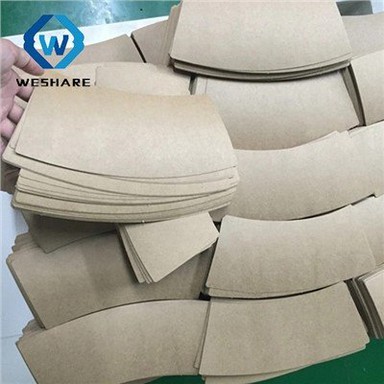
Why is it necessary to test the release force of release paper?
Dec 09, 2025
In industries such as labels, tapes, electronics, medical dressings, and packaging, release paper plays a critical but often overlooked role. Although it may appear simple, its performance directly affects production stability, product appearance, and the final usability of adhesive products. Among all performance indicators, the release force is one of the most important metrics-and this is why systematic testing is essential.

What Is Release Force?
Release force refers to the peeling strength required to separate an adhesive (such as PSA, hot melt glue, silicone adhesive, etc.) from the surface of release paper or release film.
It is usually measured in g/25mm or N/m at a constant peeling speed (commonly 300mm/min), following industry standards such as FINAT FTM3 or ASTM methods.
The release force reflects:
The curing level of the silicone layer
The uniformity of silicone coating
Compatibility between adhesive and release liner
The stability of the coating under temperature and pressure
Because of these factors, release force is not just a technical parameter-it directly affects real production output
Why Testing Release Force Is Necessary?
1. Ensures Process Stability in High-Speed Production
Label and tape manufacturers often run machines at 100–300 meters/minute.
If release force is too high:
The liner may tear during peeling
Adhesive may lift poorly
Die-cutting accuracy is affected
If release force is too low:
The adhesive may detach prematurely
Finished rolls become unstable
Products cannot be stored properly
Regular testing ensures the release paper performs consistently in high-speed automated lines.


2. Guarantees Compatibility With Different Adhesives
Different adhesives behave differently on silicone surfaces, especially:
Hot melt adhesives
Acrylic pressure-sensitive adhesives
Silicone adhesives
Medical hydrogel adhesives
Even slight deviations in silicone curing can cause:
Adhesive residue on the liner
Silicone migration
Uncontrolled release force changes after aging
Testing helps manufacturers adjust formulations for perfect adhesive–liner compatibility, reducing customer complaints and rework.
3. Prevents Silicone Transfer and Adhesive Contamination
Silicone transfer is one of the most serious failures in release liners.
When the silicone layer is improperly cured:
Silicone can migrate into the adhesive
The bonding strength of the customer's final product decreases
Electronic and medical applications may suffer from functional failure
Release force testing allows engineers to detect:
Under-cured silicone
Over-cured silicone
Uneven coating
This protects both the manufacturer and the end user from costly defects.
4. Controls Quality Consistency Across Different Batches
Large-volume B2B buyers-such as tape factories or label converters-require stable release force across all shipments. Any variation may cause:
Production downtime
Recalibration of machine tension
Increased scrap rate
By performing release force tests on every batch, manufacturers ensure consistent performance, giving buyers confidence in long-term cooperation.
5. Supports Customized Release Levels for Different Applications
Different industries require different release levels:
Low release for medical dressings and stable positioning
Medium release for labels and general packaging
High release for silicone adhesives or special industrial tapes
Differential release for liners with two functional sides
Accurate testing ensures that each customer receives exact release values tailored to their adhesive and production process.
6. Helps Predict Product Behavior After Aging
Release force can change over time due to:
Temperature,Humidity,Storage conditions,Adhesive curing behavior
Aging tests (e.g., 70°C for 24–48 hours) combined with release force measurement allow manufacturers to predict:
Long-term stability
Whether release force will rise or fall
Risks of adhesive residue or premature separation
This is crucial for industries where shelf life and stability matter-electronics, medical, and automotive.